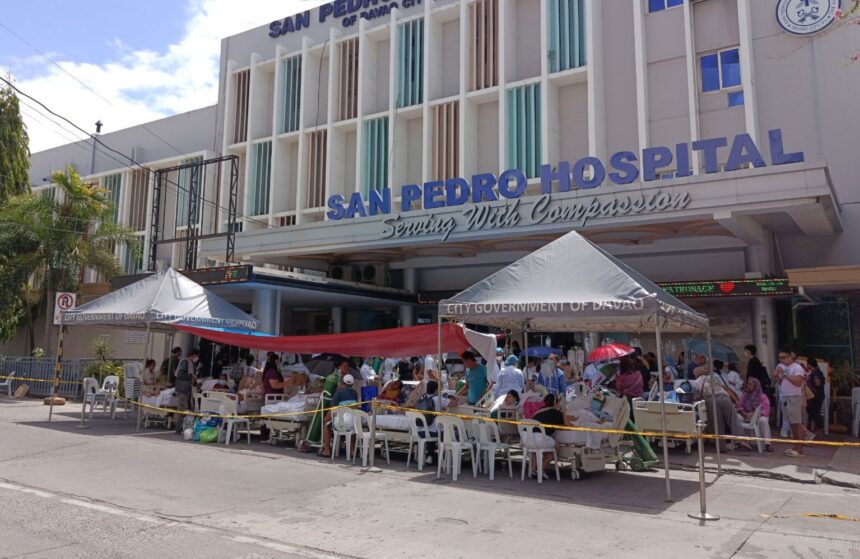
The Office of Civil Defense said (OCD) it was verifying reports that at least 19 people died due to a magnitude 7.8 earthquake that struck Maasim, Saranggani on Monday morning, June 8.
As of 3:30 p.m., the OCD said 16 fatalities were recorded in Soccsksargen (Region 12) while three were in Davao (Region 11).
“Of the 19 fatalities we are verifying, 16 are from Region 12 or Soccsksargen while three are from the Davao Region,” OCD spokesperson Junie Castillo said in a press briefing at the National Disaster Risk Reduction and Management Operations Center (NDRRMOC), Camp Aguinaldo in Quezon City.
Of the 16 dead in Region 12, there were 10 in General Santos City; three in Glan, Sarangani; two in Tupi, South Cotabato; and one in Malapatan, Sarangani.
Meanwhile, the three fatalities in Davao Region were all logged in Davao Occidental.
The OCD also reported 134 injured individuals in Regions 11 and 12 although Castillo stressed that the figures remain preliminary. At least 12 people in have also been reported missing in the affected regions.
“At the moment, Soccsksargen is the center of our operations and where we are concentrating our efforts,” Castillo said.
The earthquake affected thousands of residents, prompting the evacuation of about 10,000 families from Sarangani and Sultan Kudarat. Another 700 families were reported affected but were not necessarily evacuated.
Most of the reported fatalities were caused by debris falling from damaged structures while authorities continue to monitor reports of landslides.
“There was a report earlier of a landslide in South Cotabato. We have not yet determined how many deaths were caused by debris and how many were due to landslides,” Castillo said.
According to the OCD, the Philippine Institute of Volcanology and Seismology (Phivolcs) traced the powerful tremor to the movement of the Cotabato trench. This fault line cuts through the Celebes Sea and runs parallel to the southwestern coast of Mindanao, making nearby coastal provinces highly vulnerable to underwater disruptions and sudden tectonic shifts.
Castillo confirmed that the General Santos International Airport suffered structural damage while communication towers in General Santos City and several public facilities in Sarangani province also sustained cracks and structural failures.
Some of the 10,000 evacuated families were moved as a precaution due to a tsunami alert issued after the earthquake.
“Regarding the tsunami alert, there is an initial report being verified that there is a slight rise — one meter — in sea levels in some of the affected areas. Residents were advised to move to higher ground,” Castillo added, noting that marine monitoring teams were tracking the sea levels.
Castillo also reported that over 180 aftershocks have already been recorded as of 3 p.m., prompting local teams to issue urgent safety warnings to residents.
“Because of these aftershocks, it is difficult for people to return to buildings until assessments of their structural integrity are completed by safety officers,” Castillo said.
Power outages were reported in nine areas across Regions 11 and 12. However, Castillo said there have been no reports of disaster risk reduction and management offices becoming unreachable.
“Regarding the lifelines, there are reports of power outages when it comes to electricity, and the same goes for communication lines, so our personnel have already gone in the affected areas to reestablish these communication and power lines,” Castillo said.
The breakdown of power lines and cell signals crippled immediate disaster assessments in rural coastal towns. The national government has mobilized emergency response teams to Mindanao to handle the situation.
In Sarangani, located directly along the coastline, disaster officials faced zero visibility regarding the exact level of destruction due to the complete loss of communications.
‘Rocked like a cradle’
Rene Punzalan, head of the Sarangani provincial disaster risk reduction and management office, confirmed that local teams were caught on the road during the powerful shake.
Punzalan was traveling to his office when the earthquake hit, trapping his team on the road as the ground buckled.
“It was incredibly strong. We stopped on the road while the earthquake was happening. It was really powerful. Our vehicle was truly shaking, and it felt like it was being rocked like a cradle,” Punzalan said.
“It lasted for a long time. There was a violent shaking that eventually stopped, but it was followed by a succession of aftershocks, like a tail end that dragged on for several seconds, around 15 to 30 seconds,” Punzalan recalled. “As of now, this is truly the strongest ground shaking of this kind that we have ever felt.”
Sarangani is a coastal province composed of seven municipalities. Six of these are coastal towns situated directly along Sarangani Bay, placing the majority of its population in the direct path of potential tsunami waves.
Disaster units could not immediately confirm the total number of collapsed homes and buildings.
The earthquake also struck exactly during the opening of classes, triggering widespread panic among parents, students, and school officials.
“It happened right during the opening of classes, which is why we are closely monitoring the damage to the buildings and checking the situation in the schools,” Punzalan explained. “We cannot avoid panic, especially among our parents and students.”
Classes have since been suspended by Malacañang in the affected areas for the safety of the public.
Amid the tsunami threat, Punzalan urged residents near the shorelines to obey the forced evacuation orders issued by the seismic bureau.
“Since Phivolcs has already issued a tsunami warning, our appeal is for those in the coastal towns of the province or near the shores of Sarangani to immediately coordinate with your respective barangays for your proper evacuation. This is also for your own safety,” Punzalan said. (Martin Sadongdong)