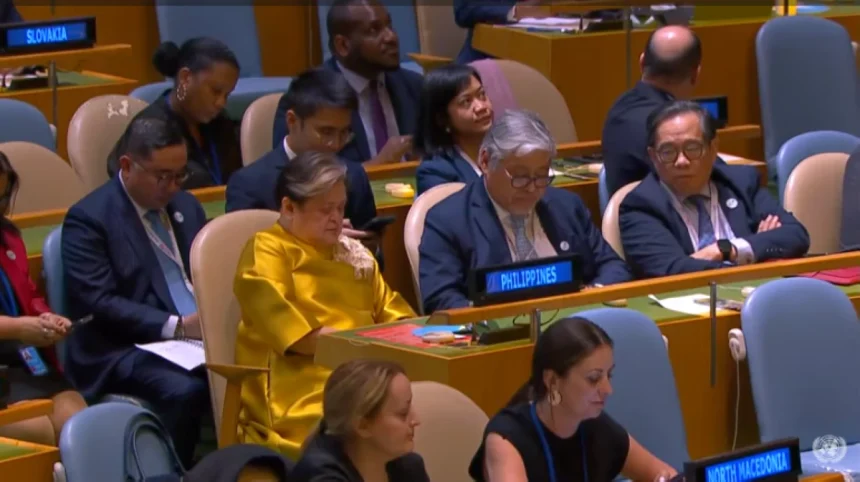
The Philippines failed to secure a non‑permanent seat on the United Nations Security Council (UNSC) for the 2027–2028 term after losing to Kyrgyzstan in four rounds of voting at the United Nations General Assembly past midnight on Thursday, June 4.
Kyrgyzstan clinched the Asia‑Pacific seat with 142 votes in the fourth round, surpassing the required two‑thirds majority of 128 out of 191 voting member states. The Philippines received only 49 votes in the final round.
In the first round held late Wednesday evening, June 3 (Manila time), Kyrgyzstan garnered 105 votes while the Philippines obtained 85.
The gap widened in subsequent rounds, with Kyrgyzstan securing 110 votes against the Philippines’ 81 in the second, and 123 against 68 in the third.
Foreign Affairs Secretary Ma. Theresa Lazaro, who was present during the voting, said the Philippines respects the outcome.
“The Philippines respects the decision of the member states of the United Nations and extends its congratulations to the Kyrgyz Republic following today’s election,” she stated.
She also expressed gratitude to countries that supported the Philippine bid, emphasizing that the campaign was anchored on peace, dialogue, international law, and cooperation among nations.
Lazaro added that despite the setback, the Philippines remains committed to working with the international community in pursuing peace, stability, sustainable development, and a rules‑based international order.
The UNSC is composed of 15 members — five permanent with veto power (China, France, Russia, the United Kingdom, and the United States) and 10 non‑permanent members elected for two‑year terms. Seats are distributed among regional groups, with the Asia‑Pacific region allotted two.
The Philippines had campaigned on issues such as maritime security, peacebuilding, climate resilience, and the interests of developing nations.
It has previously served four terms as a non‑permanent member: in 1957, 1963, 1980–1981, and 2004–2005. The 2027–2028 bid would have marked its fifth term. (Argyll Geducos)