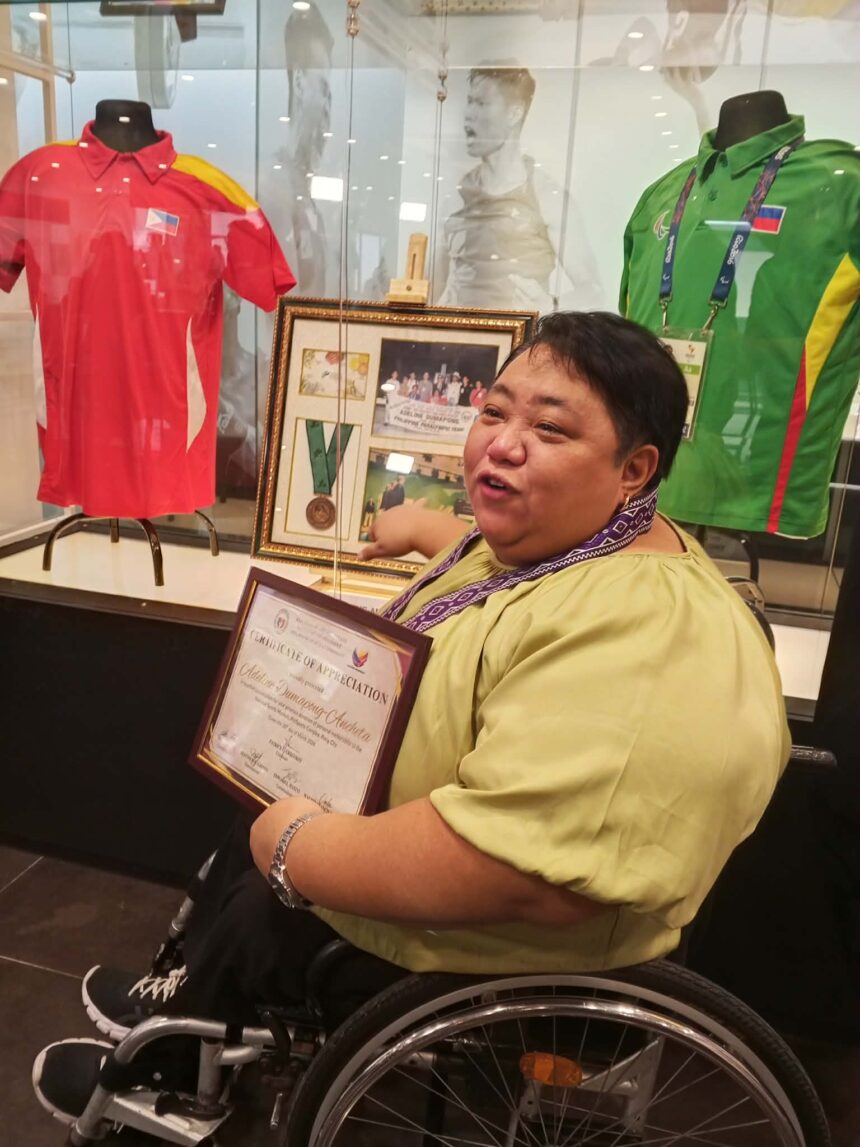
By MARK REY MONTEJO
Para powerlifter Adeline Dumapong-Ancheta still vividly remembered her journey when she delivered the Philippines’ first-ever medal in the Sydney Paralympic Games in Australia.
A glorious moment for Philippine sports, preserved in just one photo, which Dumapong’s emotion was barely seen as it captured from afar, a stark reminder of the limited support and recognition for para athletes then, with progress made but much still left to be done.
It could have been enough reason for the 52-year-old Dumapong to step away, but her patriotism only burned brighter. Decades later, she chose to dedicate her hard-earned bronze medal – one that even survived Bagyong Ondoy – to the newly established Para athletes section at the National Sports Museum inside the Rizal Memorial Sports Complex in Pasig City.
On a searing Monday morning, March 30, the love for para sports was re-ignited, especially in the distaff side as the world celebrates the women with disabilities day, more as an emotional Dumapong graced the unveiling ceremony.
“I believe that this Paralympic medal does not belong to me alone. It belongs to the Filipino people, and by placing it in the National Sports Museum, I hope it can be shared with all,” said Dumapong.
“Especially every para-athlete, every coach, every official and athlete. May it remind us of what is possible when determination meets opportunity,” she added.
In front of the current national para-athletes, Dumapong couldn’t help but break into tears as she also paid tribute to her fellow Paralympic bronze medalist, late table tennis ace Josephine Medina, whose items are displayed in the section.
“Even now, when I think about it I become emotional because I have lived through the journey… na wala man lang support, walang contribution compared to something that we have now,” said Dumapong.
“I’m emotional kasi I never imagined my medal to be displayed [dito], sabi ko nga this is not about me, but it really shows na may progress na may pagasa ang Pilipinas na kumilala ng pagkakapantay-pantay,” she added. “Pero the athletes we have now, nakakatuwa, kasi nagkaka-stories, napapansin na sila.”
Philippine Sports Commission commissioners Bong Coo and Walter Torres, and Paralympic Committee of the Philippines president Mike Barredo were also present along with several Paralympians, including para swimmer Angel Otom and para javelin thrower Cendy Asusano.
The Nationals Sports Museum, which relocated from PSC in Malate, Manila to its Pasig-based area last year, features the country’s best athletes, among them are eight-division world champion Manny Pacquiao, Efren Bata Reyes, Philippine men’s basketball and baseball teams, to list a few.
Since its first appearance in 1988 Seoul, the Philippines has won only two bronzes thanks to Dumapong (powerlifting) and Medina (single class 8, table tennis) with 21 para athletes competing in nine editions.