By Emily G. Bugarin
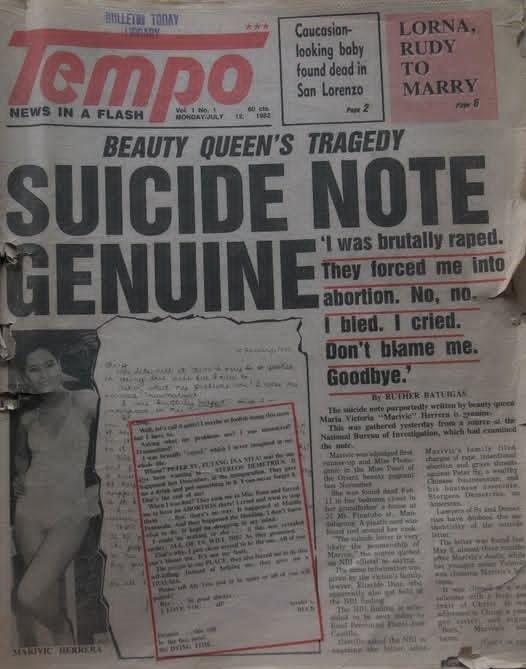
Tempo was born on July 12, 1982, as the Manila Bulletin’s first English-language tabloid. Its maiden issue carried 12 pages neatly divided into News, Sports, and Entertainment — a compact format that would soon carve its own identity in the country’s dynamic media landscape.
Conceived to “capture news in a flash,” Tempo stories were written short, simple, and substantial, aimed at the B, C, and D markets to distinguish the paper from its broadsheet parent.
Unlike its sister paper Balita, which was printed in Filipino, Tempo was published in English, though some entertainment columns appeared in Tagalog.
The launch was backed by an extensive multimedia campaign. Founding entertainment editor Nestor Cuartero recalled the management’s vision in naming the paper, saying: “We are calling our small paper Tempo to go with the times… to capture the pace, the rhythm of the city and of the country.”
Sensational first issue
That rhythm was immediately felt in its maiden issue, which carried the sensational death of Mandaluyong beauty queen Marivic Herrera. The late veteran reporter Ruther Batuigas penned the exposé under the headline “SUICIDE NOTE GENUINE,” and the story sold out all 80,000 copies of the first issue, instantly cementing Tempo’s place in the tabloid market.
From the start, Tempo’s strength lay in its format and readability. Its news section emphasized human interest, often drawn from police blotters, and delivered with dynamic reporting from young journalists.
It popularized the sidebar, companion pieces to headline stories that revealed more details and angles.
Sports and entertainment coverage proved equally lively and credible, anchored by seasoned columnists and reporters who dedicated their careers to their beats.
A newsroom joke captured this credibility: “If a story hasn’t appeared on Tempo pages, it has yet to be official,” a quip from the late pioneering sports editor Rudy Navarro that mirrored the paper’s commitment to presenting accurate stories.
High circulation era
By the late 1980s and 1990s, Tempo was reaching an average daily circulation of 280,000 copies, making it one of the country’s most widely read tabloids. Initially sustained by street sales, it later opened cautiously to advertising but retained its editorial‑first policy.
Tempo’s very first editor Recah Trinidad likened the paper’s birth to “Lighting a Candle,” underscoring the journalist’s role in seeking truth and encouraging reader participation. That foundation was carried forward by succeeding editors: Augusto Sta. Ana (1983–1999), Robert Roque Jr. (1999–2012), Rey Bancod (2012–2019), Emily G. Bugarin (2019–2026), and Patrick Ely Garcia (present).
Keeping up with the times
Tempo adapted with the times. On March 23, 1999, it expanded to sixteen full‑color pages, modernizing its look. On June 20, 2006, it launched its website, embracing the digital shift. On April 19, 2011, it opened its Facebook page, later adopted a stronger social media strategy in July 2025.
In March 2020, Tempo introduced a cleaner, more readable print layout, further enhanced in December 2024 to capture younger readers. It endured the Covid‑19 pandemic, when many competitors folded their print editions, and continued to serve readers — particularly clients who relied on its pages for extra‑judicial publishing — proving its resilience in crisis.
Now, as Tempo enters its 44th year, it continues publication in both print and digital formats. True to its founding vision, it remains a tabloid built for accessible, fast, and substantial reporting — capturing the pace of the times, the rhythm of the city, and the pulse of the nation.