By Martin Sadongdong
China’s test launch of a submarine-fired strategic missile into the Pacific Ocean has drawn strong criticism from the Department of National (DND) and Armed Forces of the Philippines (AFP) days before the country marks the 10th anniversary of its landmark arbitral victory against Beijing in the West Philippine Sea (WPS).
DND spokesperson Asst. Sec. Arsenio Andolong said the launch reflected China’s continued use of military power at a time when countries in the Indo-Pacific region were calling for stability and respect for international law.
“The Department of National Defense shares the concern about China’s recent ballistic missile test in the South Pacific, a reckless display of military power that shows little regard for smaller countries and the fragile ecological systems that sustain their people,” Andolong said on Tuesday, July 7.
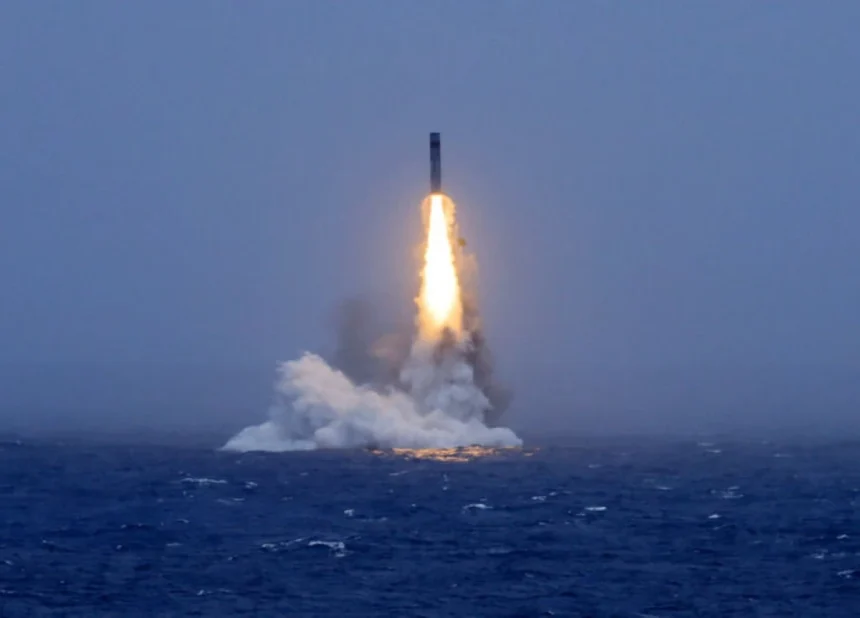
China’s People’s Liberation Army (PLA)-Navy announced that one of its nuclear submarines launched a strategic missile carrying a training dummy warhead at 12:01 p.m. on Monday, July 6. It said the missile landed accurately in a designated area of the Pacific Ocean.
The Chinese military described the activity as part of its annual training program, stating that relevant countries had been notified in advance and insisting that the test complied with international law and international practice. It also said the launch “is not directed against any specific country or target.”
Citing officials, Chinese Communist Party (CCP)-controlled propaganda outlet Global Times said the missile used in the launch was likely the JuLang (JL) submarine-launched strategic missile.
It said the missile was first displayed during China’s military parade in Beijing last year and “likely exceeds 8,000 kilometers,” making it an intercontinental ballistic missile (ICBM) allegedly capable of striking targets far beyond the Asia-Pacific region.
China conducted its first publicly acknowledged ICBM test into the Pacific Ocean in September 2024. Beijing then said the missile carried a dummy warhead and was launched as part of a routine training exercise.
However, the DND rejected any suggestion that the test was harmless. “This launch serves no peaceful purpose and is a calculated act of taunting and provocation against those who reject China’s illegal expansionism and coercive conduct,” Andolong said.
The missile test occured less than a week before the Philippines commemorates the 10th anniversary of the July 12, 2016 arbitral ruling that invalidated China’s sweeping claims in the South China Sea.
The decision, handed down by the Permanent Court of Arbitration in The Hague, affirmed the Philippines’ maritime entitlements under the United Nations Convention on the Law of the Sea (UNCLOS), but China has refused to recognize the ruling.
Meanwhile, the AFP spokesperson for WPS retired admiral Roy Vincent Trinidad said the latest missile launch only added to security concerns in the region.
“While noted as part of an annual training routine, such a demonstration of advanced strategic nuclear capability compounds existing regional anxieties,” Trinidad said.
He said the military remained guided by the government’s policy of promoting peace and adherence to international law despite continued tensions in the region.
“In line with the Department of National Defense and national government pronouncements, the AFP maintains that peace, stability, and adherence to international law must guide all state actions in the Indo-Pacific,” he said.
As the country prepares to mark a decade since its legal victory against China, Trinidad said the AFP would continue protecting the country’s maritime rights.
“We call for transparency, restraint, and a cessation of actions that escalate tensions or threaten the rules-based international order,” he said.
The DND also called on Beijing to avoid actions that could further raise tensions in the region.
“The Philippines stands with its Pacific partners in calling on China to act responsibly and stop turning shared seas into arenas of intimidation and imperial ambition,” Andolong said.