By Philippine News Agency and Glazyl Masculino
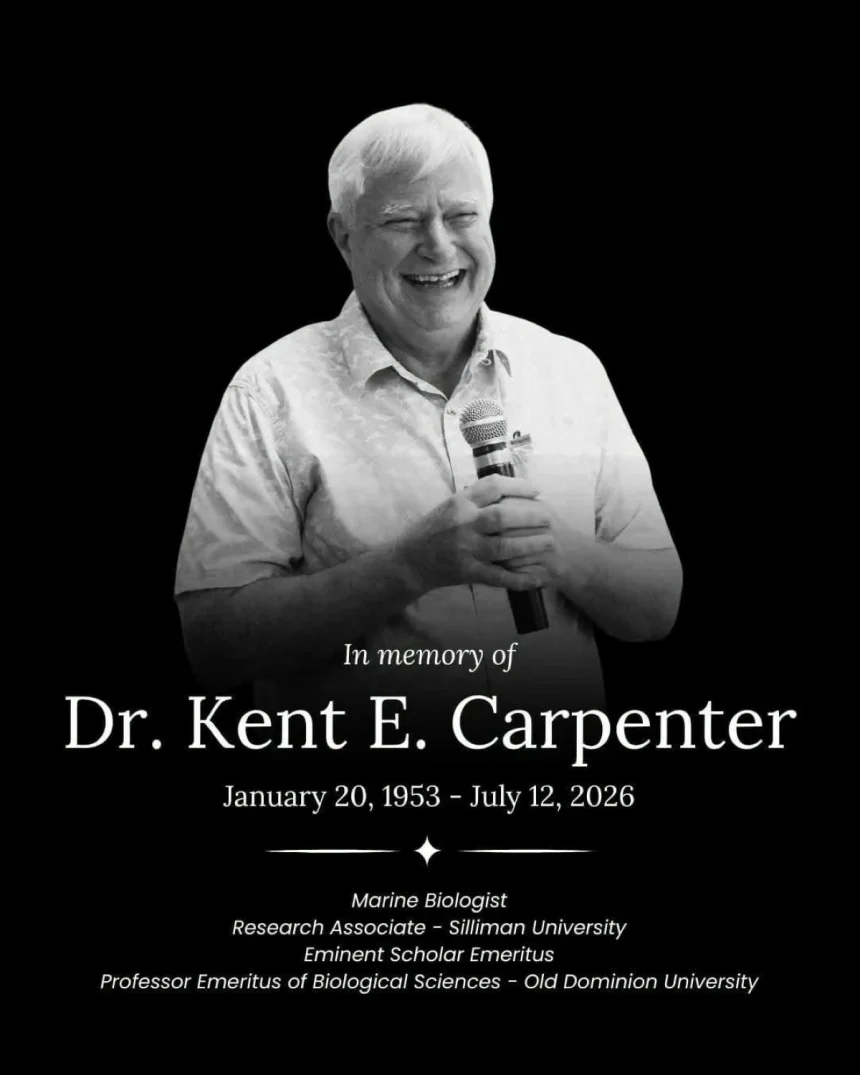
The Philippine National Police (PNP) has created a Special Investigation Task Group (SITG) to investigate the fatal shooting of American marine scientist Dr. Kent E. Carpenter and the alleged sexual assault of his Filipino partner during a home invasion in Sibulan, Negros Oriental on Sunday night, July 12.
Police Capt. Stephen Jaynard Polinar, spokesperson of the Negros Oriental Police Provincial Office, said SITG Carpenter is composed of investigators from the Criminal Investigation and Detection Group, the Provincial Anti-Cybercrime Team, Scene‑of‑the‑Crime Operatives, and other law enforcement units.
Initial findings point to robbery as a possible motive, with valuables reportedly taken from the victims’ residence, though authorities are not ruling out other angles.
Carpenter, 73, was shot in the head by three masked assailants who forcibly entered his home at around 11:30 p.m.
His 34‑year‑old partner was also assaulted and is now under the care of the Women and Children Protection Desk.
Police recovered items believed to have been stolen and assured that the case is being treated with urgency.
The incident has drawn widespread condemnation.
Negros Island Region police director Brig. Gen. Romano Cardiño vowed to exhaust all legal means to identify and apprehend the perpetrators, while the US Embassy and Carpenter’s family have been informed of his death.
Silliman University in Dumaguete City, where Carpenter served as a research associate, mourned his passing, remembering him as a pioneering scientist and mentor.
A professor emeritus of Biological Sciences at Old Dominion University, Carpenter was renowned for his work on fish biodiversity and coral reef conservation.
His landmark research identified the Verde Island Passage as the “Center of Marine Shore Fish Biodiversity,” a discovery that elevated the Philippines’ global standing in marine science.
Carpenter’s collaboration with Silliman began in 1976 alongside national scientist Dr. Angel C. Alcala, contributing to decades of studies on reef ecology, fisheries sustainability, and marine conservation.
He also spearheaded the Albatross Re‑Collection Project, revisiting century‑old marine surveys to advance evolutionary genomics research.
Silliman University described him as a generous mentor and collaborator whose work opened doors for Filipino researchers to engage with international institutions.
“We join his family, colleagues, students, and the international scientific community in mourning the loss of an exceptional scientist whose life’s work advanced the understanding and conservation of marine biodiversity around the world,” the university said.
Carpenter’s death is seen as a tremendous loss not only to his family and colleagues but also to generations of students, conservationists, and institutions enriched by his intellect and dedication.