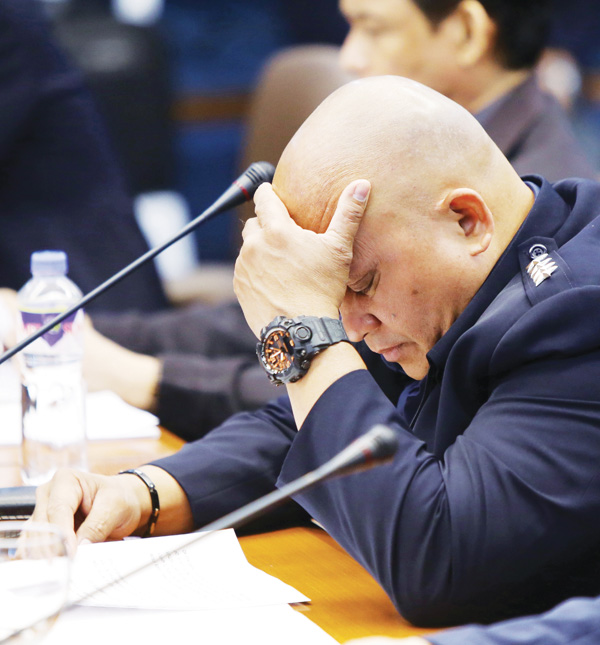
The Supreme Court on Wednesday, May 20, denied the plea of Senator Ronald “Bato” M. Dela Rosa for a temporary restraining order (TRO) to prevent the execution by law enforcers of the arrest order issued against him by the International Criminal Court (ICC).
It was not known immediately if the arrest order can now be implemented with the denial of the plea for TRO and once arrested, if Dela Rosa will be turned over to the ICC.
Earlier when some chaotic incidents happened at the Senate while Dela Rosa was under its protective custody, President Marcos had said that he had not instructed Bato’s arrest.
Legal quarters said the President’s action was most probably in respect for two equal branches of government – the Senate (legislative) which placed Dela Rosa under its protective custody and the SC (judiciary) which, at that time, had not acted on the senator’s plea for TRO.
In a press briefer, the SC’s Office of the Spokesperson said:
“The SC, in a vote of 9-5-1, denied the prayer for a temporary restraining order (TRO) and/or status quo ante order (SQAO) filed by Senator Ronald “Bato” M. Dela Rosa.
“The full Resolution and the Separate Concurring and Dissenting Opinions of the Members of the Court will be uploaded to the SC website on Monday, May 25, 2026.
“In Senator Dela Rosa’s manifestations, he prayed for a TRO and/or SQAO to prevent the Department of Interior and Local Government, the Department of Foreign Affairs, the Department of Justice, the Philippine National Police, the National Bureau of Investigation, the Bureau of Immigration, the Armed Forces of the Philippines, and the Criminal Investigation and Detection Group from arresting him on the basis of any warrant from the International Criminal Court, red notice and diffusion from the International Criminal Police Organization, or any foreign judicial or quasi-judicial instrument without a Philippine judicial warrant.
“The SC only decided on the prayers for interim relief. The main issues raised by the parties in their pleadings and motions are yet to be resolved in the main case.”
Almost six months of hiding after the ICC’s arrest order was floated in the media last November 2025, Dela Rosa appeared before the Senate last May 11 to attend the session and voted to oust Sen. Vicente Sotto III as Senate President.
Senator Alan Peter Cayetano was elected new Senate president.
The National Bureau of Investigation (NBI) attempted to serve the ICC arrest warrant last May 11 at the Senate. However, the Senate placed Dela Rosa under its protective custody prompting the NBI to back off.
In the early morning of May 14, after some chaotic incident at the Senate, Dela Rosa left the Senate building and his whereabouts remained unknown as of posting time.
The Department of Justice (DOJ) had asked the Bureau of Immigration (BI) to issue an immigration lookout bulletin order (ILBO) against Dela Rosa. With the ILBO, the BI is mandated to report to authorities if Dela Rosa would attempt to leave the Philippines.
Earlier, the BI said that its records do not show that Dela Rosa left the country.
On Wednesday morning, the DOJ said that Dela Rosa “need not hide.”
“If Senator Bato would roam around pursuant to his duties as senator for instance, we could let him do that,” said DOJ Spokesperson Raphael Niccolo Martinez.
Martinez said an order was issued to have law enforcement stand down in serving the ICC’s arrest order due to the decision of the Senate to place Dela Rosa under its custody and the pending pleadings before the SC.
Led by Israelito Torreon, Dela Rosa’s lawyers questioned the legality of the ICC’s arrest order and stressed that they will submit only to the jurisdiction of the Philippine authority.
They told the SC that “any contemplated arrest, detention, custody, transfer, turnover, rendition, or surrender of Petitioner Senator Ronald ‘Bato’ M. Dela Rosa on the basis of any ICC warrant, request, Interpol Red Notice, Diffusion, or analogous foreign or international process shall, at the very least, be subject to prior Philippine judicial authorization and to the procedural safeguards embodied in the 2025 Rules on Extradition Proceedings.”
The ICC’s arrest warrant against Dela Rosa was issued in a sealed document in November 2025. Last May 11, the ICC unsealed the document that made the warrant public.
On the other hand, the Office of the Solicitor General (OSG) which represents the government in the Dela Rosa’s motion told the SC that Section 2, Article II of the Constitution declares that the Philippines adopts the generally accepted principles of international law as part of the law of the land and adheres to the policy of peace, equality, justice, freedom, cooperation, and amity with all nations.
Thus, it said, the Constitution mandates the application of customary international law embodied in the Rome Statute that set up the ICC.
The Constitution allows the government to cooperate with the ICC despite the Philippines not being a party to the Rome Statute, and the cooperation “necessarily includes recognizing and giving effect to ICC processes such as the warrant of arrest within the Philippine jurisdiction.”
The OSG said that the ICC arrest warrant against Dela Rosa can also be legally enforced under the provisions of Republic Act No. 9851, the law that defines and penalizes crimes against international humanitarian law, genocide and other crimes against humanity.
It said that under RA 9851, the “enforcement of an ICC warrant of arrest does not require a corresponding warrant of arrest issued by a Philippine court to be enforceable within the Philippine jurisdiction.”
It also said that “Section 17 of RA 9851 authorizes the relevant Philippine authorities to surrender or extradite, as the case may be, a suspected or accused person when an international court or tribunal is already conducting the investigation or prosecution of a crime punishable under the said law.”
Thus, the OSG pointed out that “the Philippines remains legally bound to cooperate with the ICC under Domestic Law, Customary International Law, and Constitutional Principles.”
The Philippines withdrew its ICC membership during the administration of former president Rodrigo Duterte and the withdrawal took effect last 2019.
In his reply to the comment, Dela Rosa told the SC that his plea to stop the enforcement of the arrest warrant issued by the ICC does not mean that he claims exemption from legal accountability.
“Any accountability, should there be any, must be grounded in law, including when the government is the party seeking,” Dela Rosa said.
At the same time, he said he does not ask the SC to acquit him.
He stressed that “before any Filipino citizen is seized on Philippine soil pursuant to a foreign or international process, that process must first be made enforceable under Philippine law and subjected to prior Philippine judicial determination” as required by Article III, Section 2 of the Constitution.
He pointed out: “No foreign tribunal, no executive department, and no international body is the final and authoritative voice on what Philippine law requires within Philippine territory.” (Rey Panaligan)