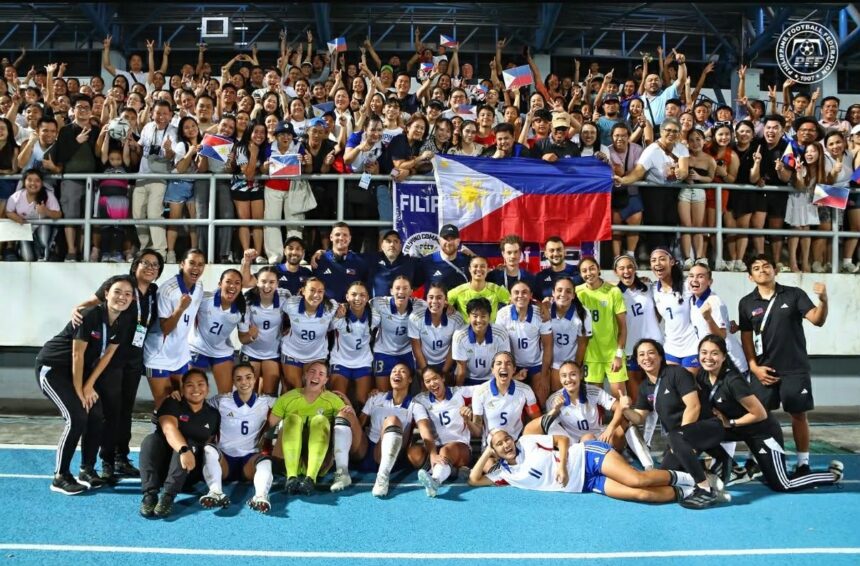
Following the Philippine women’s national team’s successful qualification for the 2027 FIFA Women’s World Cup, the Philippine Football Federation (PFF) underscored the Filipinas’ clear competitive intent and structured preparation roadmap, as detailed by head coach Mark Torcaso.
Fresh off a successful campaign in the 2026 AFC Women’s Asian Cup, where the team secured its second consecutive World Cup berth and rose to world No. 39 in the latest FIFA ranking, Torcaso emphasized that the Filipinas are not content with participation alone.
Instead, the women’s team program managed by the PFF is firmly focused on competing at the highest level and advancing beyond the group stage in Brazil.
“Our objective is very clear: we are going to the World Cup to compete and not just participate. We will do what we can to get out of the group,” Torcaso said. “That means our preparation has to be deliberate and aligned with that ambition.”
The Filipinas’ Asian Cup journey was anchored on a calculated approach, balancing defensive discipline with situational execution against top-tier opponents such as Australia and South Korea.
The strategy proved effective, enabling the team to navigate a challenging group and secure qualification through composure and consistency.
As a result, aside from World Cup qualification, the Filipinas rose up in the FIFA world ranking by two places and are now ranked 39th in the world.
“We’re pretty proud of the FIFA ranking. Over the last couple of months, we’ve been working towards getting back in the top 40,” Torcaso commented.
“That shows the commitment that everyone has put into this national team, not only in recent times, but over the last four to ten years. So we’re really excited by constantly moving up the rankings and we want to keep pushing more and more. 39 is not where we want to stop. We want to keep going.”
PFF President John Anthony Gutierrez reaffirmed the Federation’s commitment to maintaining this upward trajectory, emphasizing that the Filipinas’ success reflects a broader institutional effort to elevate Philippine football across all levels.
“Our success is built on strong relationships with our players, our coaches, and the clubs that develop and support them every day,” Gutierrez said. “This balanced approach ensures that our Filipinas are not only prepared for the World Cup, but are consistently performing at the highest level year-round.”
Looking ahead, Torcaso outlined an optimal preparation model centered on maximizing all available FIFA international windows. Beginning June, the team will engage in a globally diverse schedule, facing opponents from multiple confederations to simulate the varied challenges expected at the World Cup.
“From June onwards, we will maximize every FIFA window, expose the team to different styles across continents, and continuously raise our standards in both training and competition,” he added.