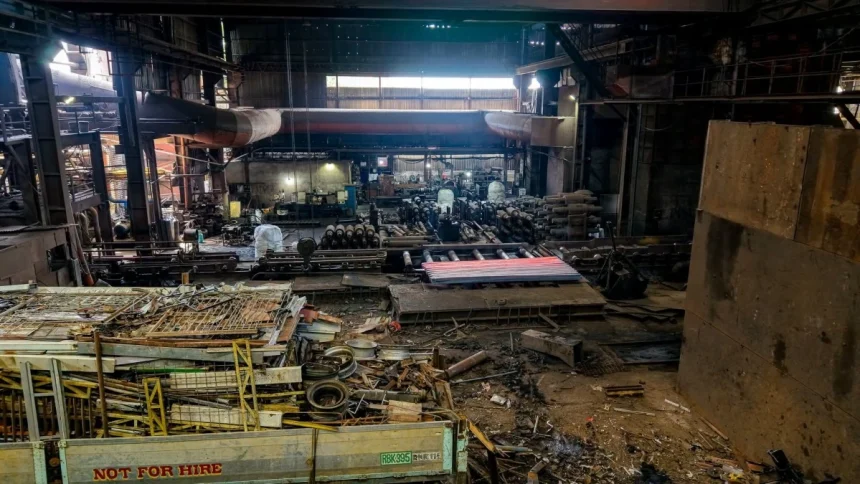
DAVAO CITY – Authorities seized materials with radioactive isotopes during a raid on a steel manufacturing facility, raising alarm over worker safety and the integrity of construction supplies.
Law enforcement agents from the National Bureau of Investigation (NBI) and Presidential Anti‑Organized Crime Commission (PAOCC) confirmed that Uranium‑238, Thorium‑228, Thorium‑232, and Radium‑226 were detected in several parts of the Davao Mighty Steel Corp. plant in Barangay Ilang, Bunawan.
The radioactive traces were found not only in furnace‑related materials, industrial powders, dust, and wastewater, but also in finished reinforcing bars already circulating in the market.
The Philippine Nuclear Research Institute (PNRI) certified that the company had no license or authority to acquire, possess, store, or distribute nuclear or radioactive materials.
The Department of Environment and Natural Resources (DENR) also flagged the firm’s Environmental Compliance Certificate, which allegedly failed to declare or authorize the handling of such substances.
The Aug. 13 operation, backed by military and Coast Guard CBRN units, resulted in the rescue of 174 Filipino workers exposed to radioactive‑bearing dust, fumes, and residues inside the facility.
Investigators further revealed that some of the seized reinforcing bars failed government quality standards, and samples of Davao Mighty Steel products were found among debris of structures that collapsed during the June 8 magnitude 7.8 Mindanao earthquake.
While officials cautioned against directly linking the steel to the failures, they stressed that the presence of radioactive traces and substandard materials poses serious risks to public safety.
The case has been referred to the Department of Justice for possible violations of the Philippine National Nuclear Energy Safety Act, the Toxic Substances and Hazardous and Nuclear Wastes Control Act, the Environmental Impact Statement System, and the Consumer Act.
Government agencies are now coordinating to secure the radioactive materials, trace products already in circulation, and prevent unsafe steel bars from entering the country’s construction supply chain.