By Diann Calucin
A fire that hit a Raon building on Tuesday has drawn attention back to a stretch of Avenida once known for its cluster of billiard halls, where players like Efren “Bata” Reyes and Francisco “Django” Bustamante were watched, wagered on, and remembered.
The blaze broke out on July 28 at the Martinez Layva Building along Rizal Avenue, corner Gonzalo Puyat (formerly Raon) and Trinidad Streets in Sta. Cruz. It reached second alarm and damaged portions of the upper floors.
Firefighters said the fire mainly affected rooms used as storage for electrical supply products.
Raon Street was officially renamed Gonzalo Puyat Street in 1984, in honor of Filipino industrialist Gonzalo Puyat, as the area evolved into a major electronics and supply district.
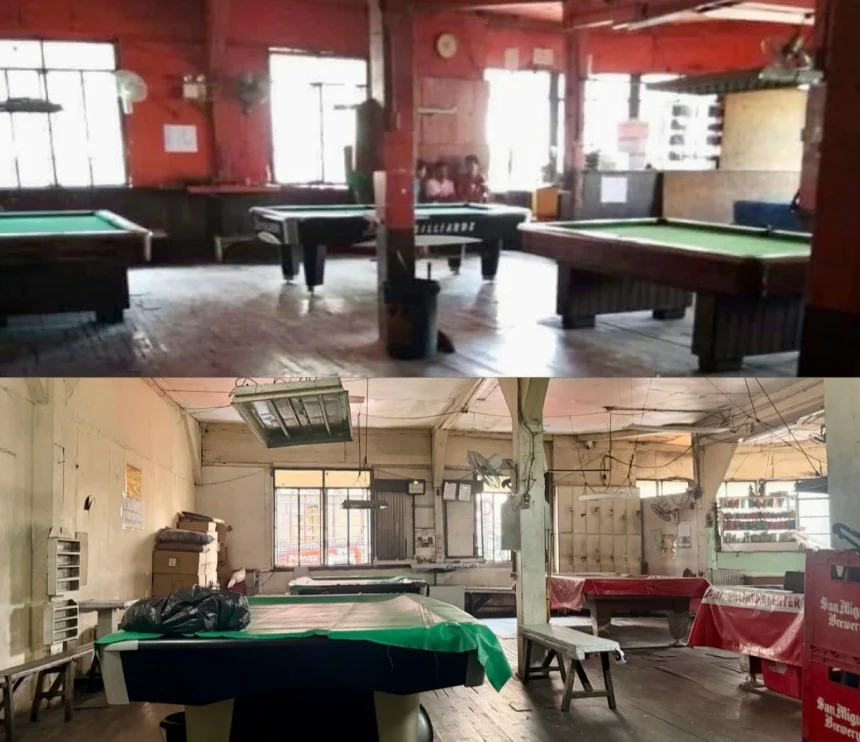
The burned structure was part of a building associated with Sunrise Billiards, one of several well-known pool halls that once operated in the area.
While formal records on the halls remain limited, local archives, photographs, and community memory place them among the billiard spots that thrived along Avenida by the 1960s and 1970s.
The building reflected typical postwar commercial design, multi-level, with high ceilings and wide-set windows, built to accommodate large crowds and the thick cigarette smoke common in billiard halls at the time.
Nearby eateries and canteens made it a regular stop for workers and students.
It was a working-class billiards scene. Neighborhood players, hustlers, and students from nearby University Belt schools gathered for money games and long hours at the tables.
“Tambayan pag nag-cutting class… noong 90s,” one recalled. Another said, “We used to frequent that place during my college days.”
Jun, a resident of 35 years, remembers the level of play.
“Diyan ko napanood maglaro ng karambola,” he said.
“Nakalaban ko diyan si Efren Bata Reyes,” he added, laughing.
It was within this same Santa Cruz corridor that Reyes honed his skills at his uncle’s Lucky 13 Billiard Hall, working as a billiard attendant in his youth, long before he became one of the most celebrated players in the world.
Across the street, the former Manila Center Billiards Hall, now operating on a smaller scale under a different name, remains open, though far from its former size.
Some sections of the space have since been converted into storage and retail areas, reflecting the shift of the district into an electronics and supply hub.
Residents recalled how matches involving Reyes would draw crowds, with spectators filling the hall and even spilling outside, placing bets and cheering as games unfolded.
“Kapag naglalaro si Bata, parang tumitigil ang mundo dito,” one resident said.
Others said top players like Bustamante would also pass through the area, further cementing its reputation as a hub for local cue-sport action.
Over time, the billiard halls gave way to rows of electronics shops, storage spaces, and commercial stalls as Raon evolved into a major supply district, leaving only fragments of its billiards past.
Reyes would later become a global icon in the sport, winning the World Pool Championship in 1999 and the World Eight-ball Championship in 2004, among numerous international titles.
Even today, the country continues to produce world-class cue artists. This week, Filipina player Chezka Centeno captured the 2026 Women’s World 8-Ball Championship, underscoring how Filipino talent in billiards remains a force on the global stage.
Today, only traces of that world remain along Avenida—reopening a chapter of Manila’s past, one lived in smoke-filled rooms, crowded tables, and the quiet beginnings of a legend.