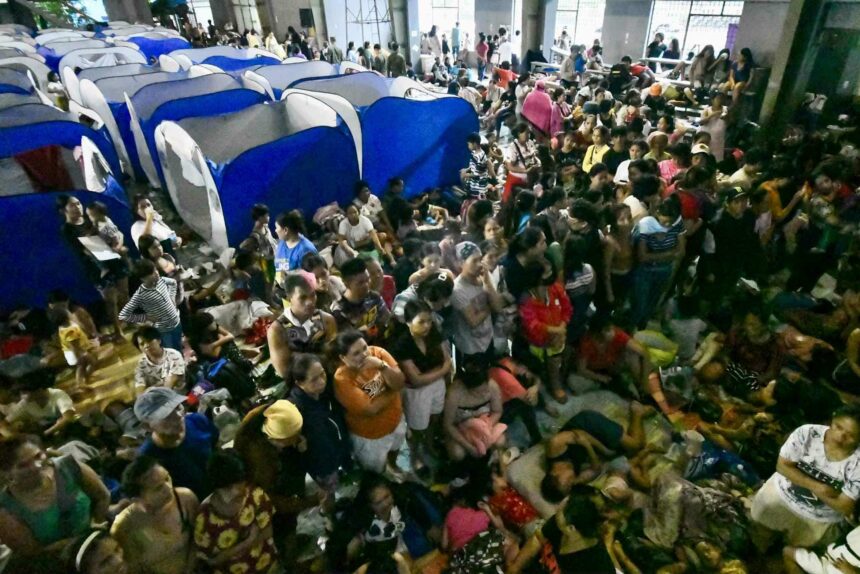
The death toll from Super Typhoon “Uwan” has risen to 18, while fatalities from the earlier Typhoon “Tino” have reached 232, according to the National Disaster Risk Reduction and Management Council (NDRRMC) on Tuesday, Nov. 11.
According to the latest situation report, Uwan left 18 people dead: 12 in the Cordillera Administrative Region (CAR) due to landslides; three in Cagayan Valley (Region 2) also due to landslides; and one each in Bicol (Region 5) due to drowning, Western Visayas (Region 6) due to electrocution, and Eastern Visayas (Region 8), the cause of which is still being validated.
There were also 28 injured individuals while two persons were reported missing.
Despite its strength, disaster officials said Uwan’s relatively low casualty count reflects the success of early evacuation efforts, with nearly 1.5 million people preemptively moved to safer areas before the typhoon’s landfall.
“As evidenced by the millions who evacuated, our preemptive actions were successful. Cooperation with local government units and the public helped keep the casualty rate low,” said Office of Civil Defense (OCD) Assistant Secretary Bernardo Rafaelito Alejandro IV.
Alejandro said relief and clearing operations have been ongoing in areas hardest hit by Uwan, particularly Catanduanes, Aurora, and Pangasinan.
“Catanduanes needs emergency shelter assistance and sustained relief distribution. In Aurora, several towns like Dipaculao, Dinalungan, Casiguran, and Dilasag were isolated but clearing of roads is ongoing. In Pangasinan, flooding remains a concern,” he said.
The NDRRMC said Uwan affected 2.35 million people or 652,632 families in 15 regions across the country. Over 803,000 individuals were staying in 10,818 evacuation centers while another 265,000 are being assisted outside.
At least 4,143 houses were reported damaged in Ilocos (Region 1), Bicol, Western Visayas, Eastern Visayas, Zamboanga Peninsula (Region 9), Caraga (Region 13), and Bangsamoro Autonomous Region in Muslim Mindanao (BARMM).
Flooding was reported in 267 areas while 299 road sections and 56 bridges were rendered impassable at the height of the storm. Power and water disruptions hit 426 cities and municipalities although restoration efforts were ongoing, according to Alejandro.
Government agencies and local units have so far provided P48.88 million worth of relief assistance, benefiting about 58,664 families, or 28 percent of those in need.
In stark contrast, the earlier Typhoon Tino, which battered parts of the Visayas and Mindanao, left 232 dead, 112 missing, and 523 injured, based on a separate NDRRMC update.
Cebu bore the heaviest toll with 150 deaths and 451 injured, followed by Negros Occidental with 42 fatalities.
Other areas include Negros Oriental with 21 dead; Agusan del Sur with six; Capiz with three; Dinagat Island, Southern Leyte, and Leyte with two each; and Antique, Iloilo, Guimaras, and Bohol with one apiece.
Tino affected more than 4.16 million people across eight regions, and damaged over 155,000 houses. It caused an estimated P337.6 million in damage to agriculture and infrastructure combined.
Alejandro said lessons from Tino guided authorities in preparing for Uwan, leading to better coordination and fewer casualties this time.
“The early evacuations and readiness of communities made a big difference,” he said.
As of Tuesday, all isolated areas in Aurora were being cleared and no additional missing persons have been reported.
Relief operations continue in affected provinces as authorities work to restore vital services and assist displaced families. (Martin Sadongdong)