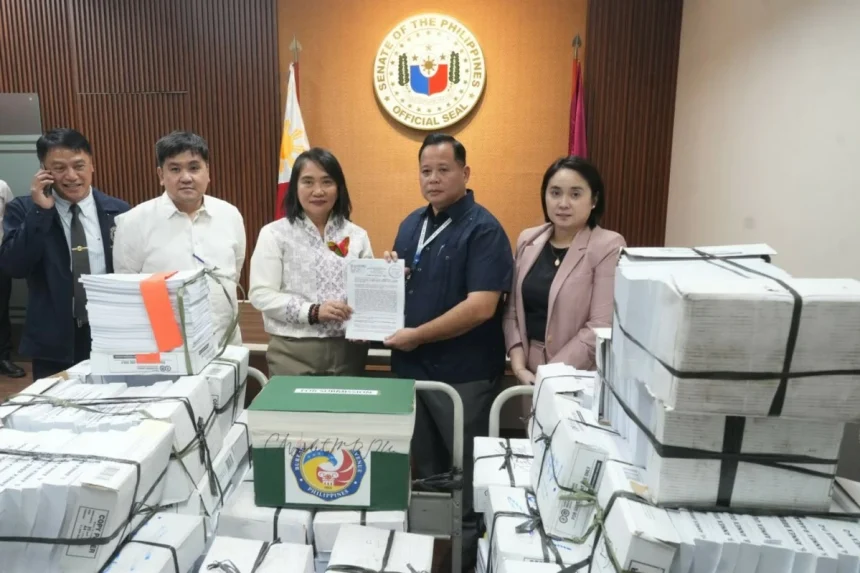
Before tensions erupted at the Senate building on Wednesday night, May 13, the House of Representatives completed its constitutional duty of transmitting the impeachment complaint against Vice President Sara Duterte to the upper chamber.
The impeachment complaint, approved by the House plenary with a vote of 257-25-9 (yes-no-abstain), was formally delivered at 7:22 p.m. by House Secretary General Cheloy Velicaria-Garafil to Senate Secretary Mark Llandro “Dong” Mendoza.
Garafil explained that the transmittal followed the reproduction, collation, and verification of thousands of pages of impeachment records and supporting attachments.
“The transmittal of the Articles of Impeachment marks the beginning of the next constitutional phase of the process, and the House Secretariat made sure that all records were complete and in proper order prior to submission,” she said, stressing that accuracy was the paramount concern.
The articles of impeachment stemmed from Committee Report No. 261, adopted through House Resolution No. 989, citing allegations of misuse of confidential funds, constitutional violations, betrayal of public trust, graft and corruption, and other impeachable offenses.
With the formal transmittal, the Senate is constitutionally mandated to convene as an impeachment court “forthwith” to try the Vice President.
Earlier, Senator Imee Marcos criticized the House for allegedly delaying the trial by citing the reproduction of “voluminous documents.” She argued that the House had sufficient staff to transmit the complaint more quickly.
Bicol Saro Party-list Rep. Terry Ridon, part of the 11-member House prosecution team, rejected claims of delay, saying the preparation was necessary to ensure due process.
He noted that unlike the first impeachment in February 2025, which was fast-tracked in plenary, the current proceedings went through the House Committee on Justice, resulting in more extensive documentation.
“Dumaan po ito sa House Committee on Justice kung saan saklaw po ng naging pagdinig at mga pagkalap ng mga dokumento at ebidensya. So rightfully so, mas makapal at mas mahaba po ’yong dokumento at ebidensyang pinaguusapan po natin,” Ridon said. (Ellson Quismorio)