By TITO S. TALAO
As memorable as his record-breaking 1992 Marlboro Tour victory — and his triumphant return in 1995 — are, what remains most seared in the mind of legendary cyclist Renato Dolosa is the one that slipped through his fingers — in 1993.
The one where Carlo Guieb, the “Eagle of the Mountain,” launched a decisive attack in the penultimate stages— two grueling climbs to Baguio City—to set up his own back-to-back Tour titles.
Dolosa, now a race commissar in the MPTC Tour of Luzon 2026 revival, recalls that moment with striking clarity. A disastrous crash along Marcos Highway, on the climb to the City of Pines from Vigan, Ilocos Sur, left him with a bloody gash on his right hand.
His breakaway companion, Loreto Mandi—the daredevil rider from Gerona, Tarlac—suffered head trauma after slamming into a pile of boulders.
At first glance, Mandi appeared worse off, his forehead grotesquely swollen. But in the end, it was Dolosa who bore the heavier cost.
He had been ahead by a commanding 25 minutes over Guieb, though only three seconds up on Mandi. As defending champion and overall leader, Dolosa paid little attention to the rider from Bagabag, Nueva Vizcaya, focusing instead on the immediate threat beside him.
“Kay Mandi ako naka-concentrate kasi malaki naman ang lamang ko kay Guieb,” Dolosa said. Even while battling the early effects of bronchitis—after his coach chose to quarter the team in an open space instead of proper classrooms—he remained firmly in control of the race.
But fate intervened.
On a blinding descent toward a tunnel along Marcos Highway, Dolosa and Mandi encountered a rough, unfamiliar stretch of road. Both riders went down in a terrifying crash.
“Nag-do-or-die si Mandi, pakamatay, doon sa tunnel,” Dolosa recalled. “Nag-eensayo kami doon at maayos naman noon, kaya dinayb ko nang todo-todo. Hindi ko alam binakbak pala yung kalye — butas-butas. Sumabog ang gulong ko, biyak ang kanang kamay ko. Si Mandi naman, kakatutok, gumulong din—wasak ang mukha.”
The crash wiped out a huge chunk of Dolosa’s lead. Guieb capitalized, erasing what remained in the next stage—an individual time trial from Rosario, La Union.
“Overall leader pa rin ako, pero next lap, time trial—isa na lang kamay ko, kaya kinain na niya ang lamang ko. Then kinabukasan, pa-Manila na, kaya tapos na ang karera. Lumamang pa siya ng two minutes.”
Now a father of three, Dolosa—originally from Gubat, Sorsogon—later settled with his young family in Biñan, Laguna. He first joined the Marlboro Tour in 1989, finishing 22nd but winning Rookie of the Year honors.
His rise was swift. He placed second behind 1990 champion Manuel “Daga” Buenaventura and third behind 1991 winner Bernardo Llentada, who famously overturned Guieb’s slim advantage in the final-stage time trial.
In 1992, Dolosa delivered a dominant performance, breaking Cornelio Padilla Jr.’s nearly three-decade-old record of 16 consecutive days in the yellow jersey by holding it from start to finish for 19 straight days.
He then watched as Guieb ruled the Tour in 1993 and 1994 before mounting a fierce comeback in 1995, when the race returned to a nationwide format with stages across the Visayas and Mindanao.
During a pre-race event at CaSoBe Canopy in Calatagan, Batangas last Tuesday, Dolosa recalled the early legs of that 1995 Tour, which were dominated by Rex Reyes Pitao in Leyte before control shifted to 1989 champion Gerry Igos. Dolosa seized the yellow jersey in Catbalogan, Samar, and defended it for 16 stages en route to his second Tour title.
He remained competitive in the succeeding years—finishing sixth behind Victor Espiritu in 1996, seventh to Hong Kong standout Wong Kam-po in 1997 (marking the arrival of international competition under the Union Cycliste Internationale), and fifth to Warren Davadilla in the 1998 Centennial race, the final edition of the Marlboro Tour after 19 years.
Dolosa’s career endured another scare in late 1995 when his parked jeepney rolled down an incline and crushed his right foot, requiring two surgeries and more than three months of rehabilitation. He recovered from that ordeal.
But not from the next.
In 2004, during a race in Baguio City, his career took an unexpected turn when his all-carbon European-issued bike—reportedly worth around ₱500,000 and kept by his mechanic in a hotel basement—was stolen.
“Ninakaw,” he said. “Gusto ko nang umayaw sa sama ng loob, pero may mga nag-advise sa akin na tapusin na ang karera. Umiiyak ako noong pababa ng Marcos Highway. Huminto na ako pagkatapos noon. Kinalimutan ko na ang cycling.”
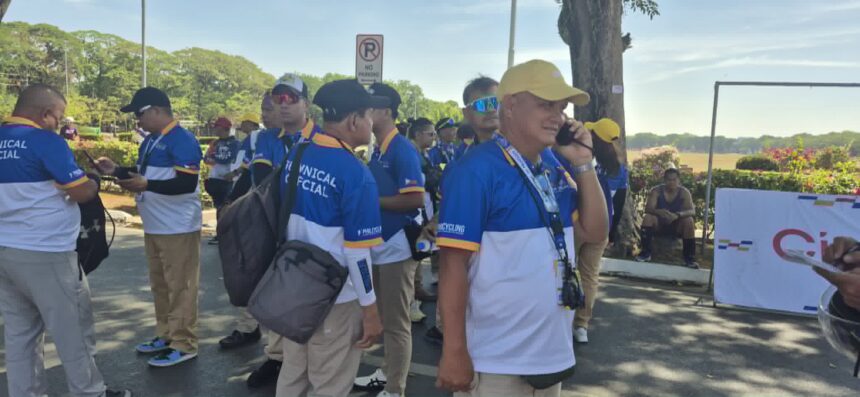
Years later, with the merging of amateur and professional cycling, Dolosa found his way back—not as a rider, but as an official. He now serves as a race commissar, including in the MPTC Tour of Luzon.
From the front seat of a commissaire’s car, Dolosa—now weighing 180 lbs from his racing weight of 130—helps keep order in the race, managing team vehicles and ensuring rider safety.
He also mentors young cyclists, including those he once coached at the national level, emphasizing discipline, preparation, focus and loyalty.
“Isa ‘yan sa mga ipinapayo ko sa mga batang siklista—maging loyal sila sa mga nag-aalaga sa kanila. Huwag na kapag may hindi lang nagustuhan, iiwan agad. Nag-invest din kasi sila—sana masuklian din ng loyalty.”