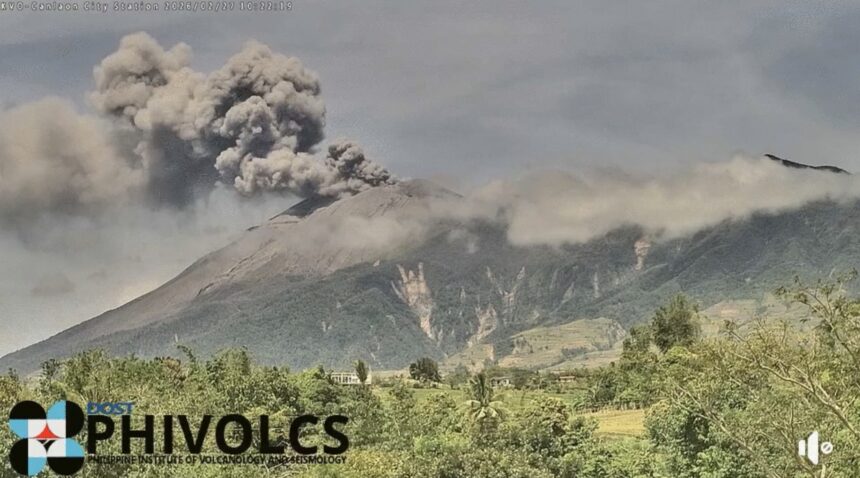
Communities across Negros Occidental experienced light to heavy ashfall after Kanlaon Volcano’s explosive eruption on Thursday night, Feb. 26, with volcanic activity continuing the following morning.
The Negros Occidental Operations Center reported ashfall in several barangays across nine local government units (LGUs), including Binalbagan, Isabela, Himamaylan City, La Carlota City, San Carlos City, Kabankalan City, Hinigaran, La Castellana, and Pontevedra.
Heavy ashfall was noted in upper barangays of La Castellana and Pontevedra, while sulfuric odors were detected in parts of Bago City, Moises Padilla, Murcia, and San Enrique.
Shock waves were felt in La Carlota City, Himamaylan, and Binalbagan, reportedly stronger than those from the Dec. 9, 2024 eruption.
Local governments activated emergency operations, deploying responders to distribute face masks and goggles, monitor affected areas, and prepare rescue vehicles.
Emergency meetings were held in La Castellana and Pontevedra to coordinate response efforts.
On Friday morning, Feb. 27, the Philippine Institute of Volcanology and Seismology (Phivolcs) recorded a fresh ash emission lasting over an hour, with grayish plumes rising about 1,000 meters above the summit crater and drifting south.
The activity was captured by monitoring cameras at the Kanlaon Volcano Observatory.
Phivolcs confirmed that Alert Level 2 remains in effect, signifying increased unrest and the possibility of sudden explosive eruptions.
Entry into the four-kilometer permanent danger zone is strictly prohibited due to risks of ashfall, ballistic fragments, pyroclastic density currents, and volcanic gases.
Authorities also warned communities near rivers and streams to remain vigilant for possible lahars during heavy rainfall, while civil aviation was advised to avoid flying close to the summit. (Glazyl Masculino, Ellalyn Ruiz)