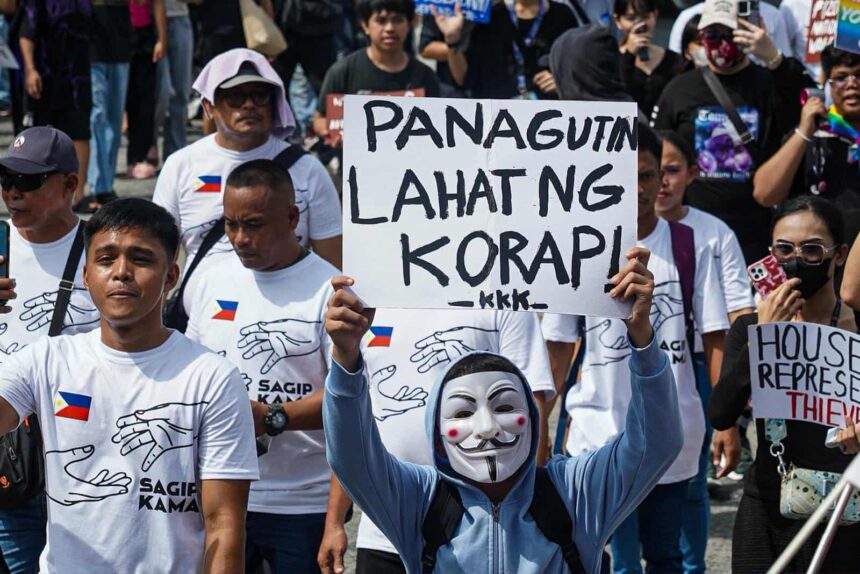
An overwhelming majority of Filipinos believe corruption in government remains rampant, with most saying it has worsened over the past year, according to the latest Pulse Asia Research survey released Wednesday, Oct. 15.
The September 2025 “Ulat ng Bayan” national survey, conducted from September 27 to 30 among 1,200 adult respondents nationwide, found that 97% of Filipinos view corruption in government as widespread, while only 3% disagreed.
“Agreement with the view that corruption is widespread in government is essentially universal, not only at the national level but also across all geographic and socio-economic subgroupings,” Pulse Asia noted.
It pointed out that the prevailing view across all areas and income classes is that corruption is “very widespread,” ranging from 75 to 82 percent across regions and 68 to 87 percent across classes.
However, those who said corruption is “somewhat widespread,” range from 14 to 22 percent across regions and 11 to 31 percent across classes.
Only 2 percent of respondents could not say whether corruption was widespread or not.
Meanwhile, 85 percent said the problem has worsened over the past 12 months, 12 percent observed no change, and 3 percent believe it has improved.
Pulse Asia said most Filipinos across all geographic areas (82 percent to 98 percent) and socio-economic classes (81 percent to 87 percent) share the sentiment that “corruption in government has increased in the past 12 months.”
The survey also found that 59 percent of Filipinos consider corruption a normal part of politics in the Philippines, while 30 percent disagreed and 11 percent were undecided.
“Except in Mindanao, this [corruption] is the majority opinion in Metro Manila (65 percent), the rest of Luzon (62 percent), the Visayas (73 percent), and every socio-economic subgrouping (58 percent to 61 percent),” Pulse Asia said.
When asked which acts constitute corruption, three in four Filipinos (75 percent) cited accepting or giving bribes, followed by misuse of public funds or company resources (67 percent), and offering or receiving kickbacks (64 percent).
Nearly half (49 percent) identified insider trading or financial fraud as corrupt acts, while smaller shares pointed to tax evasion (41 percent), nepotism in hiring or promotion (38 percent), and non-disclosure of conflicts of interest (27 percent). (EllalynRuiz)