The Department of Justice (DOJ) has reiterated its position that the Philippine government may surrender any Filipino who is subject of an arrest warrant by the International Criminal Court (ICC).
It was the same position that the DOJ issued and stood for when former president Rodrigo Duterte was arrested and turned over to the ICC authorities in the Netherlands in March last year.
“Same position,” said DOJ spokesperson Atty. Polo Martinez, referring to its stand on Duterte.
He cited Republic Act 9851 as the legal basis of such stand, which states that the Philippine government may surrender a suspected or arrested person in the Philippines to the appropriate international court or tribunal.
Under that law, or the Philippine Act on Crimes Against International Humanitarian Law, Genocide, and Other Crimes Against Humanity, “the authorities may surrender or extradite suspected or accused persons in the Philippines to the appropriate international court, if any, or to another State pursuant to the applicable extradition laws and treaties.”
But that is just one option, and according to Martinez, “The other mode is extradition.”
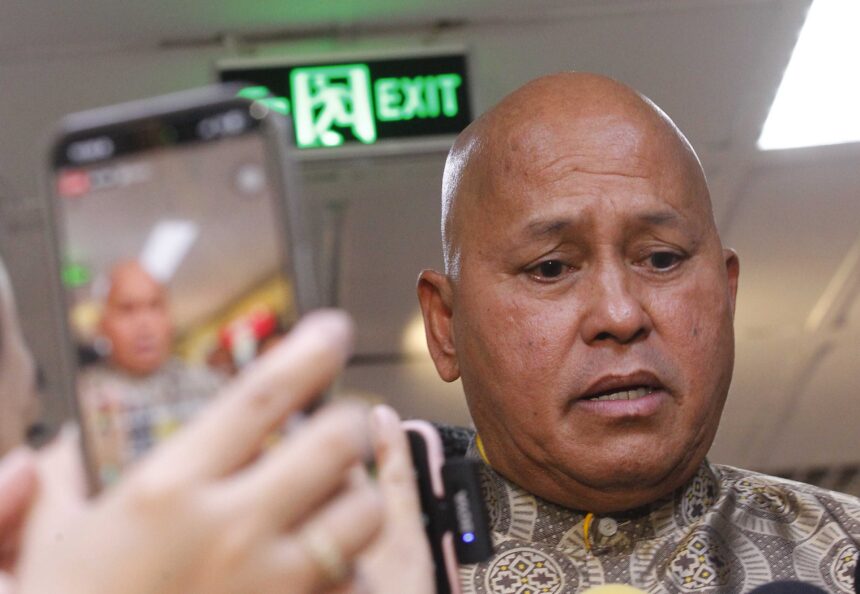
The DOJ stand was reiterated amid the issues surrounding the case of Dela Rosa who was named as co-perpetrator in the crimes against humanity case in relation to the drug war during the Duterte administration.
The Senate, under is new leadership, granted protective custody on Dela Rosa after the National Bureau of Investigation (NBI) tried to arrest him on Monday, May 11.
And such scenario in the Senate, according to lawyer Kristina Conti, was the reason why framers of the Rome Statute placed a provision that makes protective custody or any such kind of privilege irrelevant when it comes to criminal responsibility.
“When states drafted and approved the Rome Statute, they explicitly included a provision that official capacity and immunities that come with it are irrelevant when it comes to criminal responsibility before the International Criminal Court (ICC),” Conti said on her Facebook post.
In the same Facebook post, Conti posted a photo of the provisions that describes the case of Dela Rosa under Article 27 titled Irrelevance of official capacity.
“This Statute shall apply equally to all persons without any distinction based on official capacity. In particular, official capacity as a Head of State or Government, a member of a Government or parliament, an elected representative or a government official shall in no case exempt a person from criminal responsibility under this Statute, nor shall it, in and of itself, constitute a ground for reduction of sentence,” it read.
“Immunities or special procedural rules which may attach to the official capacity of a person, whether under national or international law, shall not bar the Court from exercising its jurisdiction over such a person,” it added. (Jeffrey Damicog)