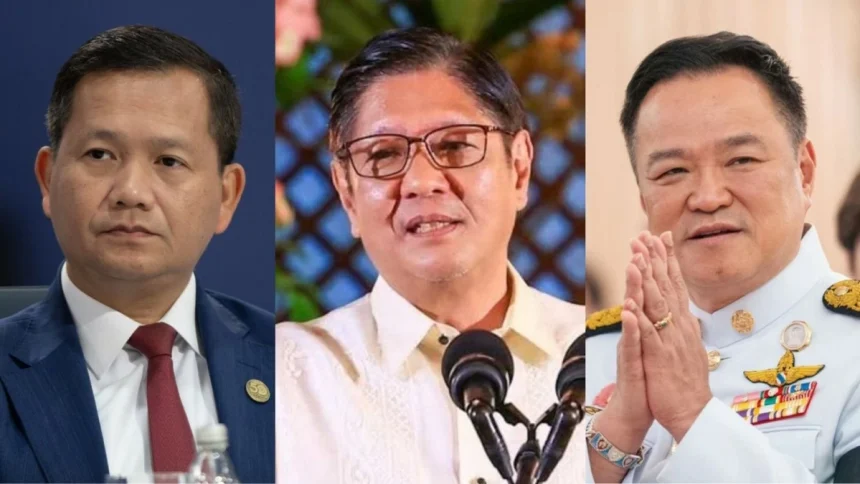
LAPU‑LAPU CITY, Cebu — President Marcos will convene a trilateral meeting with the leaders of Thailand and Cambodia as tensions continue to simmer between the two Association of Southeast Asian Nations (ASEAN) member states over their longstanding border dispute.
The meeting between President Marcos, Cambodian Prime Minister Hun Manet, and Thai Prime Minister Anutin Charnvirakul is scheduled for Thursday evening, May 7, on the sidelines of the 48th ASEAN Summit and Related Meetings here. A joint press statement from the three leaders is expected after the talks.
The trilateral meeting in Cebu comes amid renewed tensions between Thailand and Cambodia following a year of deadly border incidents, massive troop buildups, and unresolved disputes over contested territories near the Preah Vihear temple complex and the Emerald Triangle.
The current escalation began in May 2025 after a Cambodian soldier was killed during a firefight in the Chong Bok area.
This incident spiraled into a five‑day “border war” in July that saw artillery and heavy weapon exchanges, killing at least 38 people and displacing more than 300,000 residents.
Although a brief ceasefire was mediated by external powers, hostilities flared again in late 2025, bringing the total death toll since the crisis began to nearly 150, including both soldiers and civilians.
The humanitarian toll has been staggering, with the conflict triggering a large‑scale displacement crisis.
At its peak in December 2025, approximately 640,000 people fled their homes along the 817‑km border.
While many have since returned, thousands remain in displacement sites as of May 2026, facing damaged infrastructure and disrupted essential services.
Tensions further intensified this week over overlapping maritime claims in the Gulf of Thailand. On May 5, 2026, the Thai cabinet officially approved the unilateral cancellation of MOU 44, a 25‑year‑old agreement on joint energy exploration.
Prime Minister Anutin Charnvirakul cited a policy shift toward the UNCLOS framework and a “Thailand First” approach, a move that Cambodia’s Ministry of Foreign Affairs expressed deep regret over, further straining ties between the two neighbors.
Unity amid crises
The Philippines, as ASEAN chair this year, has repeatedly stressed the importance of dialogue, ASEAN centrality, and the peaceful resolution of disputes as the bloc faces multiple geopolitical and economic challenges.
On Wednesday, Department of Foreign Affairs (DFA) Assistant Secretary and ASEAN spokesperson Dominic Xavier Imperial said ASEAN remained united in addressing regional concerns despite global tensions, including the ongoing Middle East conflict.
“We do not see any impediment,” Imperial said when asked about ASEAN’s ability to issue a collective response to global crises.
“And I also want to mention ASEAN centrality — that’s very important, and it’s also a priority of the Philippines as chair to uphold ASEAN centrality,” he added.
The ASEAN Summit in Cebu is being held against the backdrop of rising global uncertainty caused by the Middle East conflict, which has disrupted energy flows, trade routes, and food supply chains.
Foreign Affairs Secretary Ma. Theresa Lazaro earlier warned that developments outside Southeast Asia could have “immediate and profound effects” on ASEAN economies.
The Philippines last chaired ASEAN in 2017. (Argyll Geducos)