By Argyll Cyrus Geducos
President Marcos said that the government has identified 30 sites in Metro Manila where underground cisterns could be built to store floodwater as part of efforts to strengthen the capital’s flood-management system.
Marcos said this during a situation briefing at the Metropolitan Manila Development Authority (MMDA) Command Center in Pasig City, where he said the detailed engineering for the proposed sites is expected to be completed within the month.
According to the President, the government is already coordinating with the authorities managing the identified areas to secure permission for excavation, with construction to begin after the sites are prioritized.
“We are already, at present time, conferring and speaking to the areas, kung sinuman ang namamahala doon sa mga area na ‘yun na pumayag sila para hukayin nga ‘yung kanilang lugar,” he said.
Among the proposed locations are Rajah Sulayman, Rizal Memorial, Camp Aguinaldo, and the University of Santo Tomas, where underground facilities could be built and the affected areas restored afterward.
The proposed cisterns are part of a broader flood-control effort that includes dredging, drainage upgrades, seawall improvements, and the operation of pumping stations and mobile pumping equipment.
Marcos has directed officials to study ways to reuse water collected through the proposed flood-storage facilities instead of simply discharging it into the sea.
“Gagawa tayo ng sistema para kung anuman ‘yung nakolekta na tubig ay magamit din,” he said.
He noted that the stored water could potentially be used for household, industrial, or irrigation purposes, adding that it would be wasteful to discard large volumes of freshwater that could still be put to use.
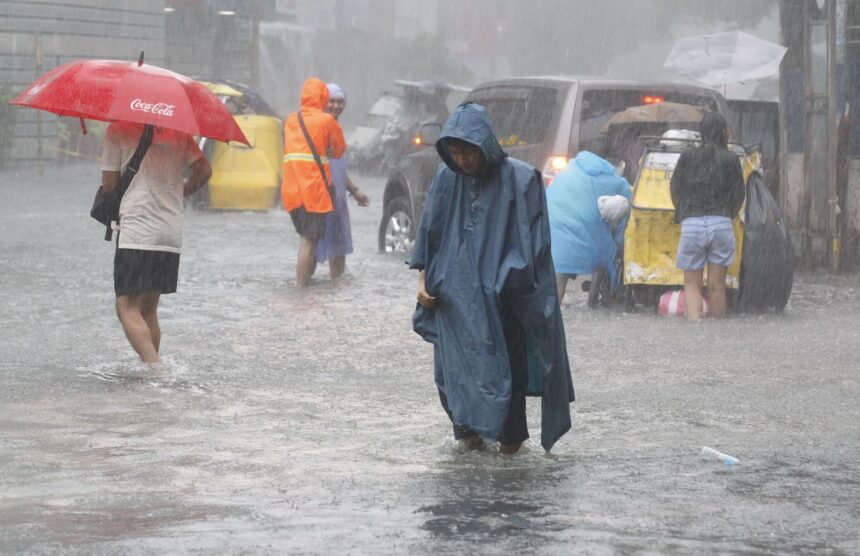
President Marcos said 4,700 barangays and 1.7 million families have been affected by the monsoon, with 27 people killed and 17 others injured.
He said some areas that previously experienced flooding as deep as two storeys were now seeing water reach only knee level, while other areas did not flood.
“Ang isa pang bagay diyan ay mas mabilis na ang paglabas ng tubig,” Marcos noted.
“Kung dati maghihintay ang tao ng dalawa, tatlong araw bago mawala ‘yung baha, ngayon wala pang isang araw ay wala na,” he said.