ABUJA, Nigeria (AP) — WHO Director-General Tedros Adhanom Ghebreyesus declared the Ebola disease outbreak in Congo and Uganda a public health emergency of international concern on Sunday after more than 300 suspected cases and 88 deaths.
In a post on X, the World Health Organization said the outbreak does not meet the criteria of a pandemic emergency like the COVID-19 pandemic and advised against the closure of international borders.
Ebola is highly contagious and can be contracted via bodily fluids such as vomit, blood or semen. The disease it causes is rare, but severe and often fatal.
Health authorities have confirmed the current outbreak is caused by the Bundibugyo virus, a rare variant of the Ebola disease that has no approved therapeutics or vaccines.
Although more than 20 Ebola outbreaks have taken place in Congo and Uganda, this is only the third time the Bundibugyo virus has been reported.
Congo accounts for all except two of the cases, both of which were reported in neighboring Uganda, the WHO said.
Officials first reported the spread of the disease in Congo’s eastern province of Ituri, close to Uganda and South Sudan, on Friday. On Saturday, the Africa Centres for Disease Control and Prevention reported 336 suspected cases and 87 deaths.
“There are significant uncertainties to the true number of infected persons and geographic spread associated with this event at the present time. In addition, there is limited understanding of the epidemiological links with known or suspected cases,” Tedros said.
Uganda on Saturday confirmed one case it said was imported from Congo, and said the patient died at a hospital in Uganda’s capital, Kampala, and the WHO said that a second case has been reported in Kampala. The two cases had no apparent links to each other and both patients had traveled from Congo, it added.
The Bundibugyo virus was first detected in Uganda’s Bundibugyo district during a 2007-2008 outbreak that infected 149 people and killed 37 people.
The second time was in 2012 in an outbreak in Isiro, Congo, where 57 cases and 29 deaths were reported.
WHO’s emergency declaration is meant to spur donor agencies and countries into action. However, the global response to previous declarations has been mixed.
In 2024 when the WHO declared mpox outbreaks in Congo and elsewhere in Africa a global emergency, experts at the time said it did little to get supplies like diagnostic tests, medicines and vaccines to affected countries quickly.
Meanwhile, Associated Press journalists in Ituri’s capital, Bunia, interviewed locals who recounted their fears and constant burials.
“Every day, people are dying … and this has been going on for about a week. In a single day, we bury two, three or even more people,” said Jean Marc Asimwe, a resident of Bunia. “At this point, we don’t really know what kind of disease it is.”
Ebola is highly contagious and can be contracted through bodily fluids such as vomit, blood, or semen. The disease it causes is rare, but severe and often fatal.
Officials first announced the latest outbreak in Congo on Friday with 65 deaths and 246 suspected cases. By Saturday, the Africa Centres for Disease Control and Prevention reported 336 suspected and 13 confirmed cases. Four people have died among the confirmed cases.
At an online briefing on Saturday, Africa CDC Director-General Dr. Jean Kaseya said the first cases were reported in Mongwalu health zone, a high-traffic mining area. “Cases subsequently migrated to Rwampara and Bunia as patients sought medical care, enabling spread across three health zones,” he said.
A high number of active cases remain within the local community, particularly in Mongwalu, Kaseya said, “significantly complicating containment and contact tracing efforts.”
Insecurity in Ituri, where Islamic State-backed militants carry out rampant deadly attacks, continues to restrict surveillance and rapid response operations, he added.
Of the 87 deaths, 57 are in the Mongwalu health zone, 27 in the Rwampara health zone and three in Bunia, Ituri’s main city.
Congolese Health Minister Samuel-Roger Kamba said late Friday that test results confirmed the Bundibugyo virus, a variant of the disease that has been less prominent in Congo’s past outbreaks. This is Congo’s 17th outbreak since Ebola first emerged in the country in 1976.
The suspected index case in the latest outbreak is a nurse who died at a hospital in Bunia, Kamba said. He said the case dates back three weeks to April 24.
He did not say whether samples from the nurse were tested, but said the person presented symptoms suggestive of Ebola.
The outbreak has spread to neighboring Uganda
Uganda confirmed Friday an Ebola case that authorities said was “imported” from Congo. The person died at the Kibuli Muslim Hospital in Uganda’s capital, Kampala, on May 14.
The Africa Centres for Disease Control and Prevention had said it is concerned about the risk of further spread due to the proximity of affected areas to Uganda and South Sudan.
The body of the patient who died in Kampala was later taken back to Congo and no other local case has been confirmed, Uganda’s Health Ministry said.
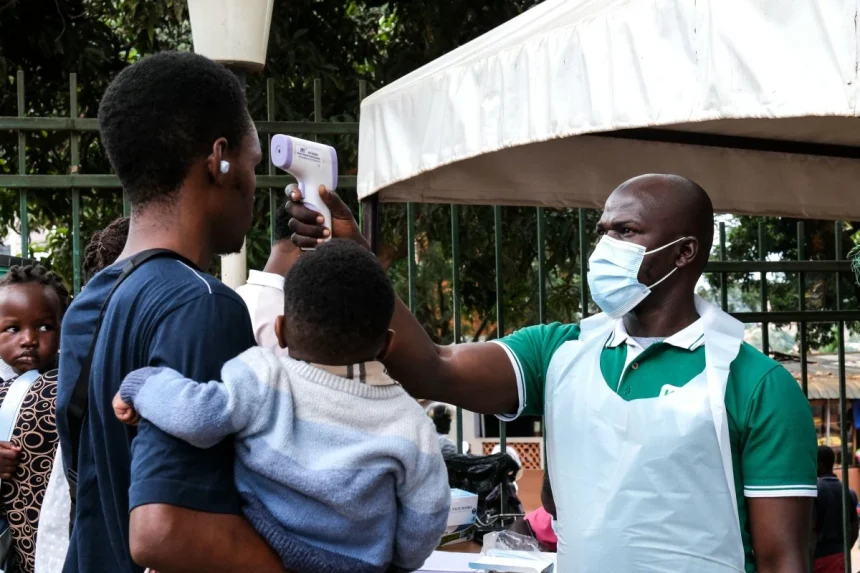
On Saturday, people were being screened at the entrance of the Kibuli Muslim Hospital.
Ismail Kigongo, who resides in Kampala, said the new outbreak reminded him of his father, whom he lost during the COVID-19 pandemic. “I really get scared because I remember burying my father without looking at his body,” he said.
Kenya, Uganda’s neighbor, said Saturday that there is only a “moderate risk of importation” of the Ebola virus due to regional travel. Kenya’s government said it has formed an Ebola preparedness team and has strengthened surveillance at all points of entry.
Congo is a large country that often faces logistical challenges
Congo has experience managing Ebola outbreaks but often faces logistical challenges in delivering expertise and supplies to affected regions.
As Africa’s second-largest country by land area, Congo’s provinces are far from one another and mostly battling conflict. Ituri, for instance, is around 1,000 kilometers (620 miles) from the nation’s capital, Kinshasa, and is ravaged by violence from Islamic State-backed militants.
Only 13 blood samples have been tested at the National Institute of Biomedical Research; 8 tested positive for the Bundibugyo strain. The remaining five could not be analyzed due to insufficient sample volume, the health minister said.
In Bunia, Ituri’s main city, businesses and regular activities in public places appeared normal on Friday.
Resident Adeline Awekonimungu said she hopes the outbreak is quickly contained. “My recommendation is that the government take this matter seriously and that it takes charge of the hospitals so that this matter can be brought under control,” she said.