By Ellalyn De Vera-Ruiz
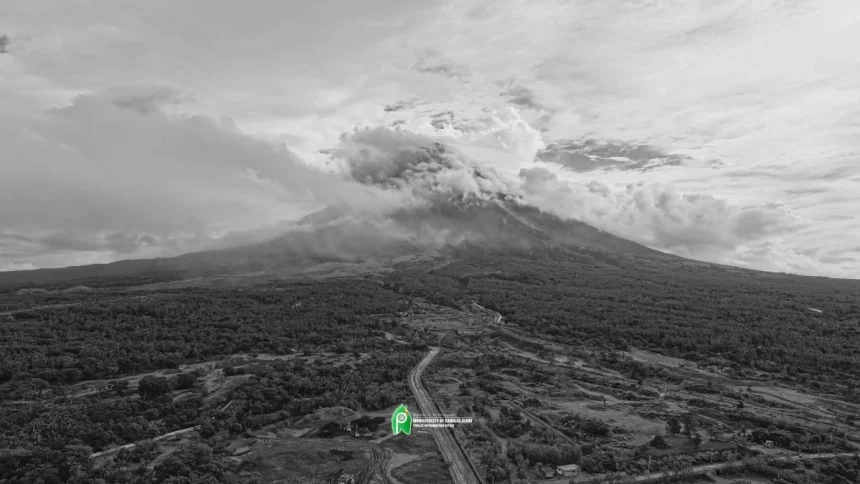
The Philippine Institute of Volcanology and Seismology (Phivolcs) on Wednesday, Aug. 5, lowered Mayon Volcano’s alert status from Alert Level 3 (intensified unrest) to Alert Level 2 (moderate unrest) after monitoring showed a sustained decline in volcanic unrest since late July.
The active volcano in Albay had been under Alert Level 3 since January 6.
“Mayon Volcano’s monitoring network and observation of day-to-day conditions have recorded a general decline in unrest since 23 July 2026,” Phivolcs said.
The agency explained that eruptive activity at the summit crater has steadily declined since peaking between July 11 and 18.
Lava flows along the Mi-isi, Bonga, and Basud gullies stopped advancing on July 22, indicating that the supply of fresh magma to the summit crater had ceased, it added.
Lava collapse-fed rockfall events also dropped significantly from an average of 278 per day since the eruption began on Jan. 6 to just 12 per day after July 23.
Strombolian eruptions and pyroclastic density currents have also ceased, with the last recorded events occurring on July 26 and July 28, respectively.
In addition, Phivolcs said volcanic earthquakes have declined, from an average of 57 events per day since the eruption began to 13 events per day after July 23.
Real time seismic energy has returned to pre-eruption levels, while sulfur dioxide (SO2) emissions have decreased after reaching a record average of 13,128 tons per day on July 11.
Despite the improvement, Phivolcs said monitoring data indicate that magma remains stored beneath the volcano, with ground deformation and microgravity measurements showing that the edifice is still pressurized.
“The lowering of the alert status should not be interpreted to mean that the volcano’s unrest has ceased, considering that the edifice is still pressurized and SO2 emission remains high relative to baseline levels,” it said.
Because of the continuing hazards, Phivolcs urged the public to refrain from entering the six-kilometer-radius permanent danger zone, because of sudden minor explosions or phreatic eruptions that could still generate short-range pyroclastic density currents, rockfalls, ballistic projectiles, landslides, and thin ashfall.
It also warned communities living near river channels draining the Mi-isi, Bonga, and Basud gullies to remain vigilant during periods of heavy rainfall.
“Given the large amounts of volcanic material deposited by the 2026 eruption, heavy to intense rainfall could generate post-eruption lahars and sediment-laden streamflow in channels draining the Mi-isi, Bonga and Basud Gullies,” Phivolcs said.
It also advised civil aviation authorities to keep aircraft away from Mayon’s summit, as ash from any sudden eruption could pose a hazard to flights.