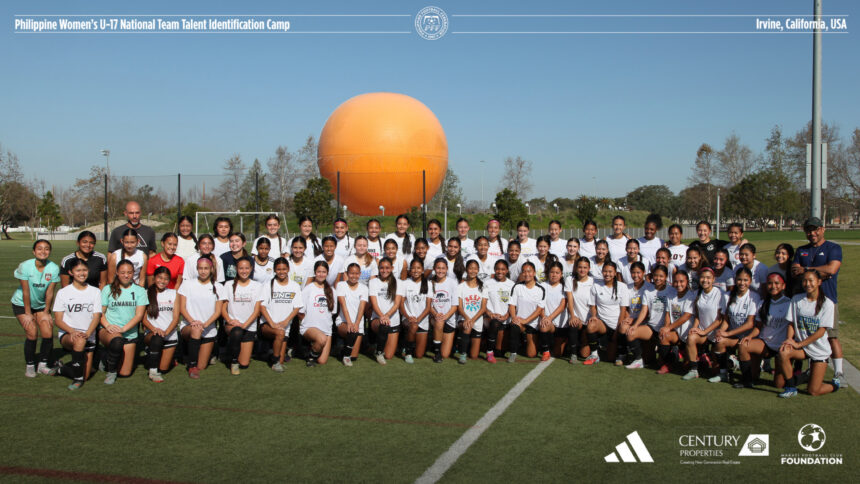
IRVINE, California — The Philippine Women’s U-17 National Team conducted a U.S. Talent Identification Camp from January 30 to February 3 at the Great Park Sports Complex here, bringing together over 150 U.S.-based Filipina players for a five-day national team evaluation program.
The camp formed a key part of the national team’s preparations for the AFC U-17 Women’s Asian Cup, which will be held in Suzhou, China, from April 30 to May 17, 2026. The tournament also serves as the qualification pathway to the FIFA U-17 Women’s World Cup.
The camp also marked the return of Nahuel “Naz” Arrarte, who will lead the program as Head Coach of the Philippine Women’s U-17 National Team. Arrarte previously served as assistant coach of the Philippine Women’s National Team in the previous World Cup, bringing continuity and extensive international experience as the team builds toward the AFC U-17 Women’s Asian Cup and World Cup qualification pathway.
The official draw for the competition is scheduled to take place on February 12, 2026, at the AFC House in Kuala Lumpur, Malaysia.
The U.S. camp marked the implementation of a structured, standards-based talent identification framework aimed at identifying, evaluating, and tracking Filipina players across multiple age groups. Participants included players born 2009 to 2011, reflecting the program’s focus on early identification and long-term development as the team builds toward continental and global competition.
The initiative represents a shift toward a more consistent and sustainable approach to talent identification, particularly for Filipina players based outside the Philippines. By evaluating players within a unified technical and developmental framework, the national team aims to strengthen continuity between youth and senior programs and build a deeper player pipeline over time.
The camp served as an identification and monitoring platform, rather than a selection event. Participation did not imply national team selection, as players are assessed and tracked longitudinally to account for the non-linear nature of youth development.
A total of 150 players participated, representing Filipina footballers from across North America. Athletes traveled from Washington, D.C., Texas, Alabama, New York, and Seattle, with additional representation from Vancouver and Toronto, highlighting the wide geographic reach of the Filipina football community.
While several players demonstrated strong potential, the national team emphasized process over individual outcomes and refrained from highlighting standouts at this stage. Evaluations from the camp contribute to an ongoing body of work rather than immediate decisions.
The camp was delivered with the support of local organizers, volunteer coaches, families, and community partners, who assisted with facilities, logistics, and player welfare.
Operating on a cost-sharing model, participant fees contributed only partially to operational expenses and were implemented to support professionalism, accountability, and a high-quality training environment. Over the five-day program, players completed 10 on-field sessions, with the national team director and head coach present and coaching throughout.
As the program continues to evolve, team management emphasized its commitment to utmost transparency in its processes and called for the continued support of the wider Filipino community, recognizing the shared role of stakeholders at home and abroad in building sustainable success.
“Seeing the depth of talent in the U.S. highlights the scale of what’s available to us as a nation. Programs like this connect homegrown players in the Philippines with Filipina talent abroad through one global platform, creating real pathways across all levels of development,” Selu Lozano, Manager, Philippine Women’s U-17 National Team said.