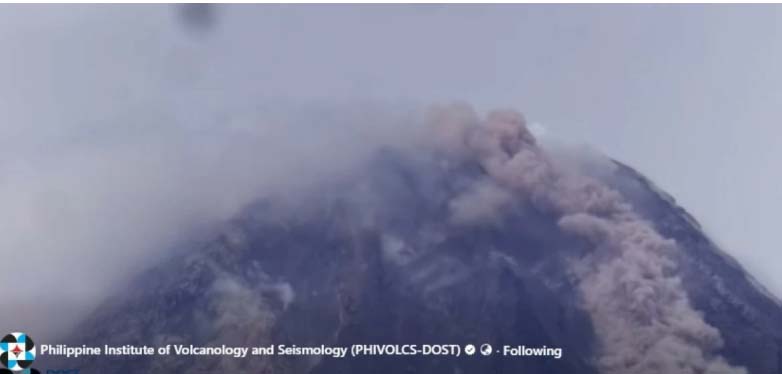
The Philippine Institute of Volcanology and Seismology (Phivolcs) announced on Tuesday, Jan. 6, that Mayon Volcano’s alert status has been elevated from Level 2 to Alert Level 3, indicating an increased likelihood of a hazardous eruption.
According to Phivolcs, since the volcano’s alert was raised to Level 2 on January 1, repeated collapses of the unstable summit lava dome have triggered a surge in rockfall events.
“DOST-PHIVOLCS is now raising the alert status of Mayon Volcano from Alert Level 2 to Alert Level 3,” the agency stated.
This escalation means Mayon is undergoing magmatic eruption activity at its summit lava dome, with heightened chances of lava flows and hazardous pyroclastic density currents (PDCs), locally known as uson, affecting the upper to middle slopes of the volcano.
Phivolcs also warned of the potential for explosive activity within the coming days or weeks.
From January 1 to January 6, Phivolcs recorded 346 rockfalls and four volcanic earthquakes, compared to 599 rockfall events reported from November to December 2025.
These rockfalls, lasting between one to five minutes, transported lava debris up to one kilometer down the southern upper slopes of the volcano.
On January 5, Phivolcs noted increased incandescence from the summit dome, indicating accelerated dome growth and the extrusion of new lava at the crater.
At 12:26 p.m. on January 6, pyroclastic density currents were observed in the Bonga Gully (southeast), extending up to two kilometers from the crater.
While sulfur dioxide (SO₂) emissions remain at baseline levels, continuous GPS, tilt, and EDM monitoring show persistent inflation of Mayon’s eastern and southeastern slopes, confirming very slow but ongoing magma extrusion, Phivolcs added.
With these developments, Phivolcs warned of potential lava flows, PDCs, rockfalls, and other volcanic hazards within the upper to middle slopes.
Residents were advised to evacuate the 6-kilometer Permanent Danger Zone (PDZ).
Authorities also cautioned about possible lahars and sediment-laden streamflows along channels draining the volcano, while pilots were advised to avoid the summit due to the risk of ash affecting aircraft.
Based on prevailing winds, Phivolcs said ash fall is most likely on the southern side of Mayon Volcano. (Merlina Hernando-Malipot)