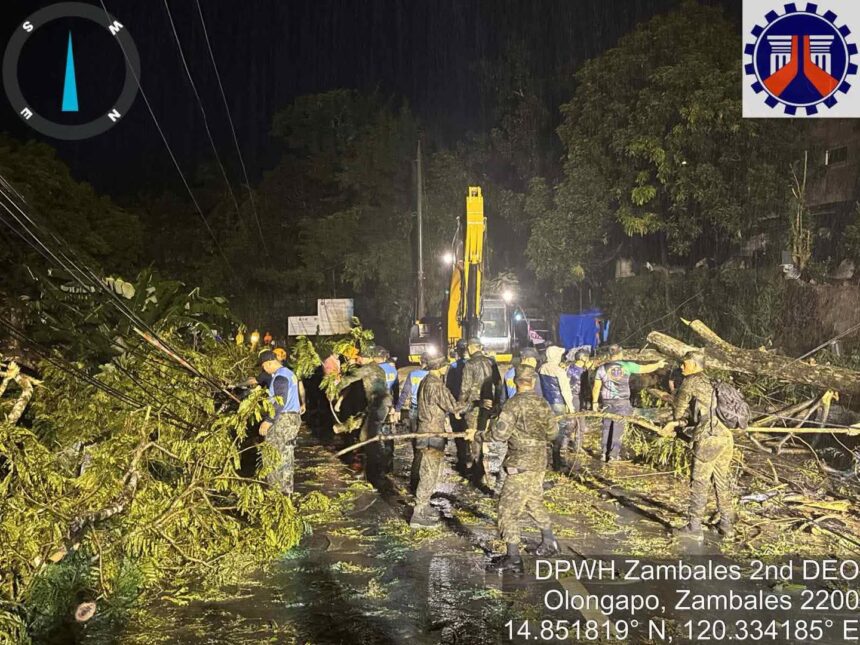
Super Typhoon Uwan battered large parts of Luzon and Visayas, unleashing widespread flooding, landslides, and power outages that left at least two people dead, around 830,000 individuals affected, and thousands stranded in ports, the Office of Civil Defense (OCD) reported Monday, Nov. 10.
One fatality was recorded in Viga, Catanduanes due to drowning, while another occurred in Catbalogan City, Samar when a structure collapsed, said OCD Assistant Secretary Bernardo Rafaelito Alejandro IV.
Two people were also injured in Bicol (Region 5) and Eastern Visayas (Region), though these figures remain subject to validation.
The death toll was far lower than that of Typhoon Tino, which claimed 224 lives.
Officials attributed the reduced casualties to the preemptive evacuation of over 1.4 million individuals—426,000 families—from high-risk areas across 13 regions, with the bulk coming from Bicol, Eastern Visayas, and Calabarzon.
According to the National Disaster Risk Reduction and Management Council (NDRRMC), 230,955 families—or 836,572 people—were affected across 2,710 barangays in Regions 2, 4A, 5, 6, 8, 9, 10, and 13.
Of these, 317,691 individuals were housed in 6,069 evacuation centers, while 164,923 sought shelter with relatives or in makeshift accommodations.
Initial reports listed 1,085 damaged homes—89 totally destroyed and 996 partially damaged—mostly in Regions 6, 9, and 13.
Validation of agricultural and infrastructure losses is ongoing.
“We don’t have data yet on infrastructure and agricultural damage, but reports are coming in and will be validated to determine the extent and cost,” Alejandro said.
Although Uwan has exited Luzon, lingering rains continue to pose risks of flooding and landslides in Central and Northern Luzon, as well as Metro Manila.
“Hindi pa po tapos ang bagyong Uwan bagamat lumampas na po siya. May panganib pa rin ng mga ulan sa ilang lugar,” Alejandro warned.
At least 132 barangays in Regions 4B, 5, 6, 9, 10, and 13 experienced flooding, while several areas reported storm surges and landslides.
In Aurora Province, the municipalities of Dipaculao, Dinalungan, Casiguran, and Dilasag were temporarily isolated due to landslides following Uwan’s landfall in Casiguran.
The Department of Public Works and Highways (DPWH) deployed 165 personnel and 10 units of heavy equipment across NCR, Regions 1, 2, 3, 5, and 8 to clear 15 impassable road networks.
A total of 87 roads and 29 bridges were affected by flooding or structural damage.
Power outages hit 170 cities and municipalities in Regions 1, 3, 4A, 4B, 5, 6, 9, and 13, with restoration underway in 15 local government units. Water supply interruptions were reported in 15 localities in Regions 4A and 5, with two areas already restored.
Communication lines were also disrupted in 14 municipalities in Region 5.
Search and rescue operations are ongoing, with 894 composite teams from the AFP, PNP, PCG, and BFP deployed, supported by 190 assets.
An additional 3,497 teams and 7,308 assets remain on standby.
Relief efforts are in full swing, backed by P2.6 billion in standby funds and stockpiles from the Department of Social Welfare and Development (DSWD) and OCD.
Around P6.4 million worth of food items have been distributed, including 4,776 family food packs sent to Regions 4A, 5, NIR, and 13.
The Department of Health (DOH) also mobilized P156 million worth of medical logistics. (Martin Sadongdong)