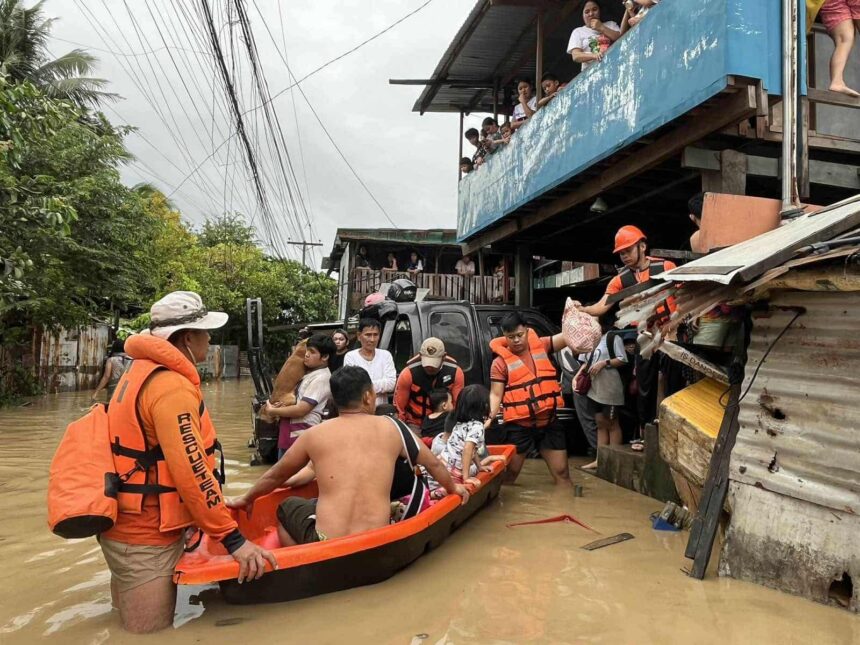
Typhoon “Tino” carved a deadly path across the Visayas, leaving at least 66 dead – 49 of them from Cebu province – amid widespread flooding and landslides that struck communities overnight, the Office of the Civil Defense (OCD) reported Wednesday, Nov. 5.
Government agencies scrambled to deliver relief aid, restore electricity, and clear blocked roads as floodwaters continued to isolate hard-hit areas.
OCD Assistant Secretary Bernardo Rafaelito Alejandro IV, civil defense deputy administrator for administration, said Region 7 suffered the most casualties, with Cebu bearing the brunt of the storm’s destruction.
“Relief and response operations are ongoing. Our response cluster is fully activated, led by the Department of Social Welfare and Development (DSWD) and Department of Health (DOH) for medical needs while the Armed Forces of the Philippines (AFP) Philippine Coast Guard (PCG), Philippine National Police (PNP), and Bureau of Fire Protection (BFP) are taking charge of search, rescue, and retrieval efforts,” Alejandro said in a radio interview.
He added that rapid damage and needs assessments were ongoing, especially in Palawan and parts of Central Visayas, where the storm’s impact remained severe.
Official data from the National Disaster Risk Reduction and Management Council (NDRRMC), however, placed the verified death toll at 52, including 50 in Central Visayas (Region 7) and two in Eastern Visayas (Region 8). Thirteen people remained missing, and at least 10 others were injured across the two regions.
ANOTHER STORM
While still reeling from the impact of Tino, the OCD said it has started preparing for another tropical depression monitored outside the Philippine Area of Responsibility (PAR), eastern portion of the country, which could strengthen into a super typhoon this weekend.
“Rest assured, all agencies are on full alert. We ask everyone to remain vigilant, cooperate with authorities, and heed warnings for your safety,” Alejandro said.
Meanwhile, Tino affected 706,549 individuals or 203,595 families across seven regions, including Mimaropa (Region 4B), Bicol (Region 5), Western Visayas (Region 6), Negros Island Region (NIR), Central Visayas (Region 7), Eastern Visayas (Region 8), and Caraga (Region 13).
A total of 348,554 individuals were staying in nearly 3,894 evacuation centers while another 88,357 individuals were sheltering with relatives or friends. There were 215,190 residents preemptively evacuated before the typhoon’s landfall.
The storm damaged 21 roads and five bridges in Regions 4B, 6, 7, and 13; with 15 still impassable due to flooding and debris. Power interruptions were also reported in 61 cities and towns in Regions 5, 6, 7 and 13 although restoration efforts were underway, particularly in Cebu and Southern Leyte.
“The Department of Energy has activated Task Force Kapatid to fast-track power restoration in affected areas,” Alejandro said.
The entire province of Cebu, composed of 53 cities and municipalities, was placed under a state of calamity due to the extent of damage.
According to the NDRRMC, the government has so far provided P31.16 million worth of assistance to affected families, with the DSWD leading the effort.
Alejandro said President Marcos Jr. has directed all national agencies to stay on the ground for early recovery efforts.
“Even as we continue search and rescue, we are already activating the early recovery cluster to address emergency housing and rehabilitation needs,” he said. (Martin Sadongdong)