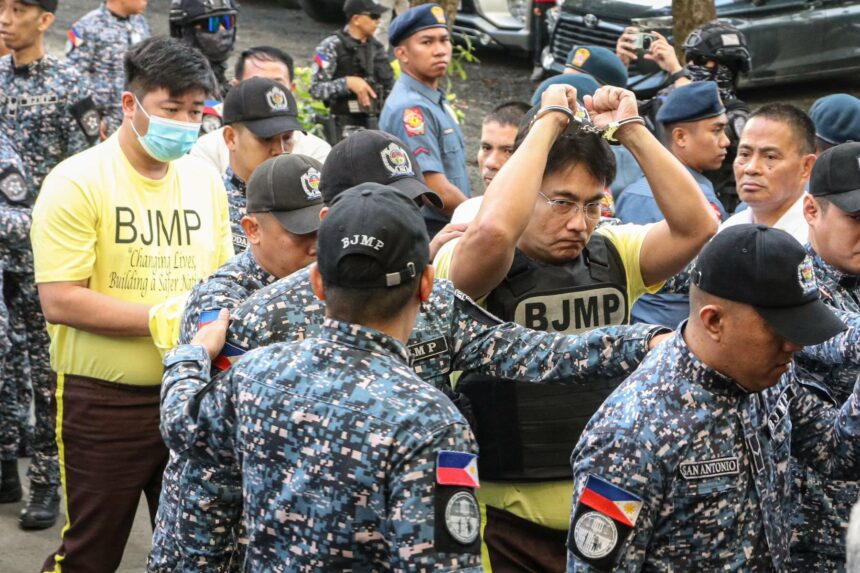
The Sandiganbayan on Monday, Feb. 16, entered a “not guilty” plea for former senator Ramon “Bong” Revilla Jr. after he refused to enter any plea during his arraignment on the non-bailable malversation of public funds case involving the P92.8 million “ghost” flood control project in Pandi, Bulacan.
This was the second time in recent weeks that Revilla declined to plead, with the court also recording a “not guilty” plea for him on Feb. 9 in a separate graft case.
His arraignment on the malversation charge proceeded after the court denied, on Feb. 10, his motion to inhibit Third Division Chairperson Associate Justice Karl Miranda from handling the case.
Meanwhile, Department of Public Works and Highways (DPWH) Bulacan District Accountant Juanito Mendoza entered a “not guilty” plea during the same arraignment.
Earlier, Revilla’s co-accused – former DPWH Bulacan District assistant district Engineer Brice Hernandez; engineers Jaypee Mendoza, R.J. Domasig, and Emelita Juat; and cashier Christina Mae Pineda had pleaded “not guilty.”
All the accused are detained at the male and female dormitories of the Quezon City jail in Barangay Payatas.
They have been charged by the Office of the Ombudsman with violations of Article 217 in relation to Articles 171 and 172 of the Revised Penal Code on malversation of public funds through falsification of public documents and graft under Republic Act No. 3019, the anti-Graft and Corrupt Practices Act.
The criminal charges stated that Revilla and his co-accused conspired to facilitate the release of approximately P76 million for the supposed construction of the P92.8 million flood control project in Purok 5, Barangay Bunsuran, Pandi, Bulacan, a project which, based on official inspection and witness accounts, was “never implemented.”
The indictment also stated: “Despite the absence of any actual construction, the respondents declared the project completed. Thereafter, to facilitate the release of the entire project cost, the respondents were found to have falsified accomplishment reports, issued fraudulent billing documents, and endorsed disbursement vouchers.” (Czarina Ong Ki)