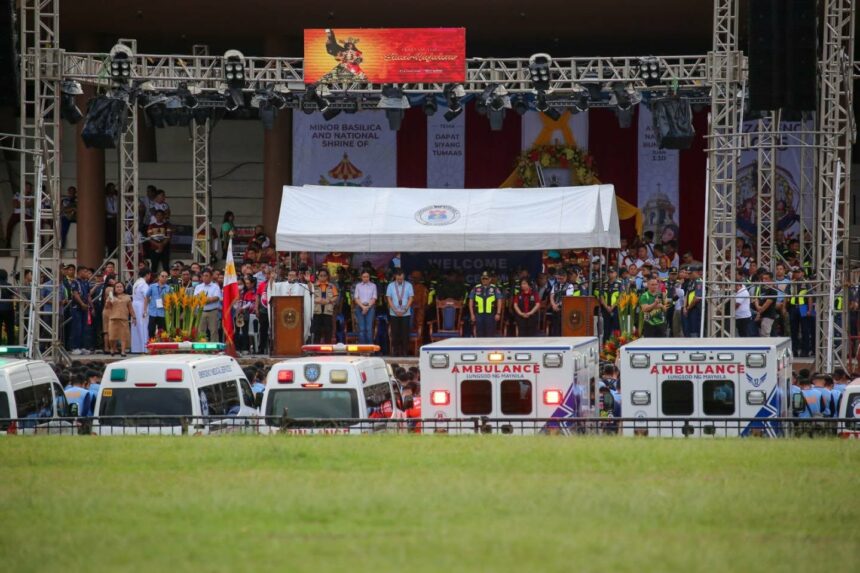
Police, medical teams, and city personnel have been mobilized across Manila as the city braces for the annual Jesus Nazarene Traslacion on Friday, Jan. 9, with millions of devotees expected to join the centuries-old procession.
Mayor Francisco “Isko Moreno” Domagoso has signed three Executive Orders suspending work in city government offices and classes in all schools, imposing a liquor ban within 500 meters of Quiapo Church and along procession routes, and enforcing a citywide ban on firecrackers and pyrotechnics from Jan. 8 to 9.
Violators face fines and on-the-spot apprehensions, with police and local enforcers authorized to act immediately.
The measures are meant to safeguard the solemnity of the Traslacion, according to Domagoso who led the send-off of security and safety forces at Quirino Grandstand.
The Manila Police District has deployed 18,000 personnel, while the Department of Health has set up 20 emergency response stations along the route—from Quirino Grandstand and Rizal Park to Ayala Bridge and P. Casal Street.
More than 200 health workers will be on duty, with DOH hospitals placed under Code White Alert to respond to cases of heat exhaustion, dehydration, and other medical emergencies.
Domagoso also assured the public of the structural integrity of key bridges, including Quezon, Carlos Palanca, Ayala, and Arlegui, all certified safe by the Department of Public Works and Highways.
Quiapo Church officials have reinforced crowd control ropes, reducing buffer zones from 50 to 30 meters after repeated breakages in past years. They appealed for cooperation, stressing hopes for a safe procession.
The “andas” carrying the revered image of Jesus Nazarene has been upgraded with a four-wheel system, steering wheel, underchassis, and braking mechanism to improve stability.
The glass enclosure has been redesigned with ventilation features, while the cross was shortened to discourage devotees from climbing onto the carriage—changes aimed at preventing injuries while preserving tradition.
Thousands queued overnight for the traditional “pahalik” at Quirino Grandstand, where organizers introduced a new system with priority lines for senior citizens, pregnant women, and persons with disabilities.
Some devotees expressed frustration over delays, but church leaders emphasized the need for order.
Health officials, meanwhile, urged those with medical conditions to reconsider joining the physically demanding procession.
As anticipation mounts, authorities remain on full alert—police, medical teams, and city personnel vowing to ensure that the centuries-old Traslacion of Jesus Nazarene is observed solemnly, safely, and in an orderly manner. (Diann Calucin)