
As expected, Vice Ganda serves his trademark zingers in “Call Me Mother”. True to what the trailer promised, however, the film also offers a glimpse of Vice attempting drama, an effort that is good enough to be appreciated, though still in need of refinement.
The film recalls Lino Brocka’s “Ang Tatay Kong Nanay” in its exploration of a gay man navigating parenthood—or, more precisely, motherhood.
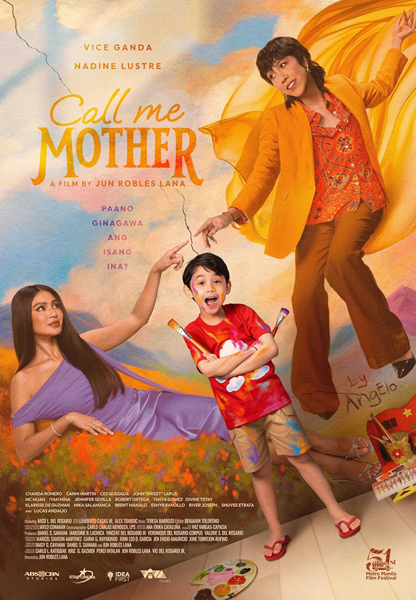
Vice plays Twinkle, a successful trainer of pageant beauty queens whose world is turned upside down after his mother’s death.
He is left to raise Angelo, the child of Mara (Nadine Lustre), born out of wedlock and kept a secret as Mara pursued her Miss Uniworld dreams.

A decade later, Twinkle struggles to make ends meet while raising Angelo on his own. An opportunity to work in Hong Kong arises, but bringing Angelo along requires legal adoption. This forces Twinkle to seek Mara’s consent, only to discover that she has plans of her own.
Wanting to know the son she abandoned, Mara grows closer to Angelo, unsettling Twinkle, who hastily pushes the adoption proceedings and asks Mara not to endear herself too much to the child.

The narrative is simple and straightforward, but the writers clearly had fun padding it with imaginative, often hilarious sequences that land unexpected laughs. The result is a colorful, enjoyable romp that entertains even viewers who may not normally warm up to Vice Ganda’s brand of humor.
The supporting cast proves just as effective in delivering comedy, often matching Vice beat for beat.
There are histrionics aplenty, but these are played knowingly, as parodies of old-school melodramas rather than straight-faced emotional excesses.

Beneath the laughter, the film also attempts to answer what motherhood truly means. Its answer is uncomplicated but heartfelt: motherhood is about presence, sacrifice, and putting a child’s well-being above one’s own dreams. As for mothers like Mara who initially choose absence, the film suggests that biology alone is not enough—they must still earn their place in their children’s hearts.
Nadine Lustre is magnificent as Mara, effortlessly holding her own in both comedy and drama. She matches Vice in comedic timing just as convincingly as Vice tries to keep pace with her in serious scenes.
Vice’s dramatic effort is earnest—you can feel how badly he wants to prove himself—but it often feels practiced and unnatural, as though carefully rehearsed rather than lived.
There’s also the sense that he might break into laughter at any moment, coupled with a visible reluctance to fully surrender control of his expressions.
Among the supporting cast, River Joseph makes a strong impression despite limited screen time as the affable, supportive, and wealthy boyfriend.
John Lapus is predictably comfortable as Mama M, a role that feels tailor-made for him.
Esnyr steals scenes with his flamboyantly gay character, though one wishes he had more lines and moments.
Iyah Mina’s Miss J provides steady laughs, while Chanda Romero delivers an assured, subdued performance perfectly suited to her role.
In the end, “Call Me Mother” is as vibrant as it is funny—an accessible crowd-pleaser that entertains first but still finds room to reflect on love, sacrifice, and the many forms motherhood can take.