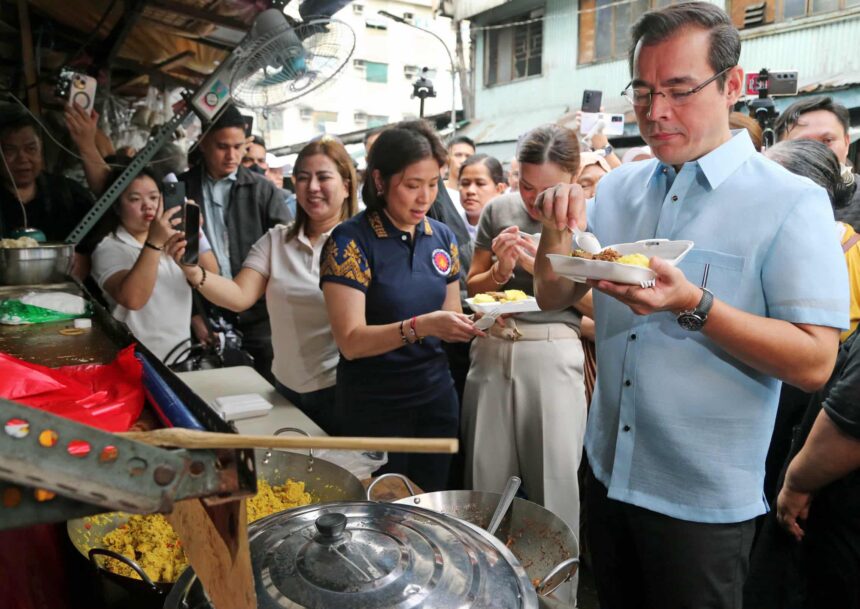
Manila Mayor Francisco “Isko Moreno” Domagoso on Monday, Nov. 3, underscored the city’s push to balance economic growth with cultural preservation, as the Department of Budget and Management (DBM) approved plans for the long-awaited Halal Town and the major rehabilitation of the Golden Mosque Complex in Quiapo—a district where Muslims and Christians have long lived, worked, and worshipped side by side.
Domagoso met with DBM Secretary Amenah Pangandaman at the City Hall to discuss preparations for the two major projects, which are expected to boost Manila’s cultural tourism and economic vitality ahead of the country’s hosting of the ASEAN Summit next year.
The mayor had earlier met with National Commission on Muslim Filipinos (NCMF) Regional Director Dimapuno Datu Ramos Jr. to advance the Halal Town project – similar to Chinatown and Korea Town in Manila — as the city continues to become a famous food destination.
He also proposed certifying restaurants that serve traditional Islamic cuisine.
Pangandaman lauded the city government’s concept and assured her agency’s readiness to provide support.
“When I saw your project on TV, the Halal Town, and taking care of our Muslim brothers and sisters in Manila, I was so happy and excited,” she said.
She also expressed her gratitude to the United Arab Emirates (UAE) government for funding the major rehabilitation of the Golden Mosque Complex, a historic site originally built during the time of the late President Ferdinand Marcos Sr.
The restoration follows directives from President Ferdinand “Bongbong” Marcos Jr. and First Lady Liza Araneta-Marcos to upgrade the mosque.
The rehabilitation aligns with the city government’s efforts to promote religious harmony and cultural tourism.
Pangandaman emphasized the strategic proximity of the Golden Mosque and Quiapo Church – two sacred sites just streets apart – as a testament to Manila’s interfaith unity.
“For those who are Muslim, pwede silang pumunta dito; ‘yung mga Katoliko naman, papasyal din dito. Then, there’s exchange, maganda po siya for tourism prospects, trade, work, jobs, and livelihood, among others,” Pangandaman explained.
Domagoso echoed the sentiment, highlighting Quiapo’s role as a living example of peaceful coexistence.
“Subconsciously alam natin: Quiapo is Muslim, and Quiapo is Nazareno. Dalawang alam natin sa Quiapo. We’re very happy to have a community where Christians and Muslims live together, grow up together, and do business together, in harmony and in a peaceful manner,” he said.
He also expressed gratitude to DBM officials for backing the city’s initiatives.
“With the help of Secretary Pangandaman and the national government through the leadership of President Marcos, malaking bagay ito para sa ating mga Muslim brothers and sisters. I was very excited to present our small effort in aligning the city’s goals with the national government — especially as we are hosting the ASEAN,” he said.
Domagoso also shared that Vice Mayor Chi Atienza earlier went to Malaysia to study its best practices in halal trade and urban management, following discussions with the Malaysian envoy and business leaders.
“They said it’s a billion-dollar industry. Kailangan lang nating pinuhin para mas maganda, mas maayos, mas malinis, mas ligtas, at mas payapa ang paghahanapbuhay sa Maynila,” he noted.
He stressed that the city aims to balance economic activity and order by identifying specific zones for commerce and ensuring accessibility and safety for both vendors and visitors. (Patrick Garcia)