By CALVIN CORDOVA
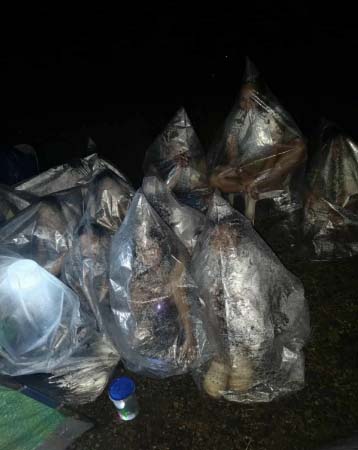
CEBU CITY — Days after a powerful 6.9-magnitude earthquake struck northern Cebu late Tuesday night, Sept. 30, residents of Medellin, the town after Bogo City – the epicenter of the tremor – are opting to sleep by the road or rice fields as aftershocks continue to shake the ground.
“People are sleeping by the road. They are still traumatized. They are afraid to sleep in their houses because aftershocks are strong,” Medellin Mayor Edwin Salimbangon told reporters on Thursday, Oct. 2.
As they slept in open areas, some residents covered themselves with plastic sheets to protect them from the rain, insects, and other elements. Others used tents as makeshift shelters.
He said the town could not also use its evacuation center as cracks were found in the edifice following the earthquake.
Salimbangon confirmed that 12 residents died while 76 others were injured during the quake.
He said the town is thankful that help has been coming but they need more.
“We are very thankful that help has been pouring in. Our problem with water supply has been solved. We are also receiving food packs. At least, it minimizes the problem,” Salimbangon said.
Four bridges in Medellin were damaged but are now passable to light vehicles.
“Temporary repairs were made by the Department of Public Works and Highways. The four bridges are now passable but only for light vehicles,” Salimbangon said.
Salimbangon said they will give P5,000 to each displaced family.
OVER 2,000 AFTERSHOCKS
Meanwhile, the Philippine Institute of Volcanology and Seismology (Phivolcs) reported a staggering 2,461 aftershocks as of 6 a.m. on Oct. 2 — just 32 hours after the main quake.
Of these, 498 were plotted by multiple seismic stations, with magnitudes ranging from 1.0 to 5.0.
Though only 13 were strong enough to be felt, the sheer volume of tremors has kept residents on edge.
Phivolcs warned that aftershocks may continue for days or even weeks, prolonging the anxiety and displacement of affected communities. (with a report from Ellalyn Ruiz)