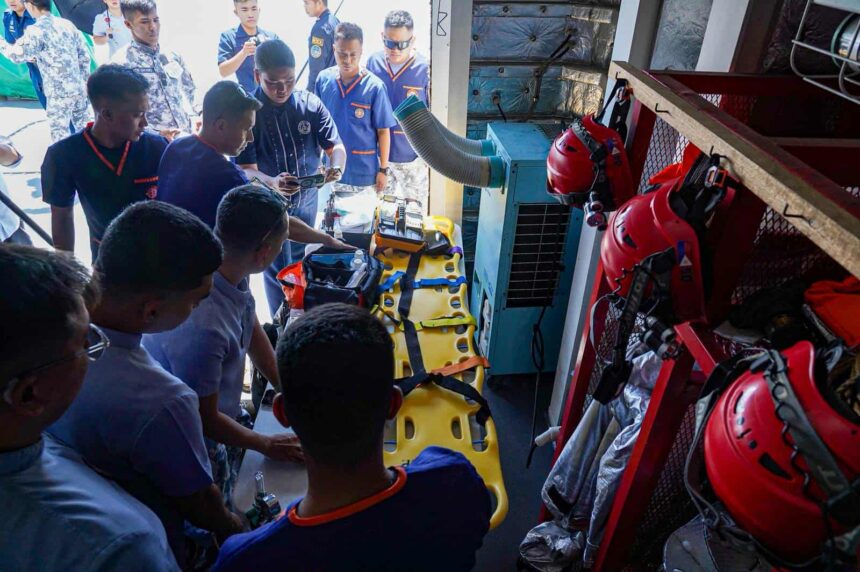
Search and rescue (SAR) operations intensified across northern Cebu following a magnitude 6.9 earthquake that struck Tuesday evening, Sept. 30, with cadavers recovered and numerous reports of trapped victims under collapsed structures.
While Bogo City remains the epicenter and hardest-hit area, SAR efforts have also been deployed in surrounding municipalities including San Remigio, Tabuelan, Medellin, Catmon, Daanbantayan, and San Francisco, where casualties and injuries continue to rise.
The quake occurred at 9:59 p.m., with its epicenter traced 17 kilometers northeast of Bogo City. It had a depth of focus of 10 kilometers and was tectonic in origin.
In a press briefing at 11 a.m. Wednesday, Oct. 1, Office of Civil Defense (OCD) Assistant Secretary for Administration Bernardo Rafaelito Alejandro IV said the full force of the OCD, including all 41 member-agencies of the National Disaster Risk Reduction and Management Council (NDRRMC), was mobilized for disaster response.
According to Alejandro, the death toll already reached 69, with casualties mostly caused by collapsed structures and falling debris in Cebu (Region 7).
Bogo City had the most fatalities with 30; followed by San Remigio with 22; Medellin with 10; Tubogon with five; and one each in Sugod and Tabuelan.
“The numbers are still very fluid. We are still in the golden hour of our rescue operations,” Alejandro said.
“We are still receiving reports that some barangays need assistance for rescue. Many people are still reported trapped or pinned under debris caused by the earthquake.”
At least 147 individuals were injured across the affected municipalities. The Cebu Provincial Hospital in Bogo City was described as “overflowing with dead people,” prompting immediate reinforcements from the Vicente Sotto Memorial Medical Center and other Department of Health (DOH) hospitals.
Cadavers were reportedly lying beside patients due to the lack of facilities.
The DOH, along with the Management of the Dead and Missing (MDM) Cluster led by the Department of the Interior and Local Government (DILG), is working to address the situation.
SAR units from the Armed Forces of the Philippines (AFP), Philippine National Police (PNP), Bureau of Fire Protection (BFP), and Philippine Coast Guard (PCG) have been deployed across the region.
The PCG sent BRP Teresa Magbanua to transport medical personnel and equipment from Manila, while additional vessels and two C-130 aircraft from the Philippine Air Force (PAF) carried more rescue teams and gear.
Regional disaster response teams from Eastern Visayas were also mobilized.
Defense Secretary Gilberto Teodoro Jr. flew to Cebu to assess the situation and activated the Inter-Agency Coordinating Cell (IACC) to streamline logistics and response efforts.
The earthquake affected three regions: Western Visayas (Region 6), Central Visayas (Region 7), and Eastern Visayas (Region).
More than 1,000 evacuees have been monitored, many camping in open spaces out of fear of further structural collapse.
The Department of Public Works and Highways (DPWH) is organizing teams to assess critical infrastructure, while the Department of Energy (DOE) is evaluating power needs to reenergize affected areas.
Alejandro assured that food, water, shelter repair kits, and hygiene supplies from the OCD and Department of Social Welfare and Development (DSWD) are being distributed to evacuees.
A major challenge remains the communication system, hampered by widespread power outages across northern Cebu. (Martin Sadongdong)