More than 100,000 college students who rely only on government support to continue their studies are at risk of losing their subsidies, as the House of Representatives struggles to find more funds.
Some school campuses may also be forced to close because of unpaid debts that the Commission on Higher Education (CHEd) is having trouble settling.
These issues—and others—came up during a long eight-hour budget hearing on Thursday, September 11, held by the House Committee on Appropriations.
During the session, CHEd pleaded with lawmakers to approve its request for more funding to help students stay in school and to cover billions in unpaid obligations owed by state universities and colleges (SUCs).
CHEd Chairperson Shirley Agrupis, who inherited the problems upon her assumption of the position in May 2025, is facing a tough decision to decide on the fate of those students.
Some students have already been hit twice by subsidy cuts, and many more could lose their support entirely.
CHEd is the lead agency of the United Student Financial Assistance System for Tertiary Education (UniFAST), a government body that handles all the government’s financial assistance to tertiary education students.
Under UniFAST, there are four institutionalized programs, namely the Free Higher Education, the Tertiary Education Subsidy (TES), the Student Loan Program and the Free Tech-Voc Education and Training.
CAUSE OF THE PROBLEM
In 2018, student-beneficiaries under TES had received subsidies amounting to P60,000 per student per academic year.
But the subsidies were slashed to P30,000 per academic year, and again to P20,000 as the commission needed to compromise its funding for a new program that was only lately initiated by Congress—the Tulong Dunong Program (TDP).
“The Tulong Dunong Program is not part of identified program under Tertiary Education Subsidy…This Tulong Dunong is an initiative of the congressman. They pick their beneficiaries that is outside the guidelines specified by the TES, so kahit middle class, o kahit anak ng mayaman, medyo mayaman, mahirap (so even the children of the middle class, the rich, the partially rich, and poor), we respect that,” Agrupis said during the hearing.
“Ang problema na kine-create nitong Tulong Dunong is that year one, nag-identify ang aming tiga-suporta na congressman ng beneficiaries na magtatanggap ng allowance; year two, wala na pong ibibigay (The problem that this Tulong Dunong creates is that the congressmen would only extend assistance within just one year after his or her endorsement, but eventually lets go of the students on the second year onwards),” she said.
Since CHEd could not simply let students under Tulong Dunong lose their subsidies, what the commission did was to adjust its funding for its other programs, she said.
For year 2026, CHEd is seeking P27.4 billion for its UniFAST. That amount is just enough to sustain the subsidies of the existing 713,747 students under TES and the 338,963 students under TDP.
It has also requested an additional P8.6 billion to cover the other 135,000 students under TDP as well as the new ones identified by the Department of Social Welfare and Development (DSWD).
If it is not granted, those students are at risk of losing their subsidies, Agrupis warned solons during the Sept. 1 hearing of the House Committee on Higher and Technical Education.
Zamboanga del Norte 3rd district Rep. Adrian Michael Amatong said only 10 percent of the CHEd’s supposed beneficiaries from his district actually received subsidies.
Amatong also disclosed that some school owners in his district were allegedly selling slots to students so they may become UniFAST beneficiaries.
He then ordered an investigation into the matter.
UNPAID DEBTS
Meanwhile, ACT Teachers Party-list Rep. Antonio Tinio also raised alarm over CHEd’s deficiencies or unpaid debts to various SUCs worth P6 billion, which had been accumulated from 2022 to 2024.
Tinio cited for example the case of Polytechnic University of the Philippines (PUP), which was previously partly subsidized by the local government (LGU) until the creation of the Free Higher Education Act.
“Pero nang nagkaroon ng Free Higher Education Law ay binitawan na nga mga LGUs (But when the Free Higher Education Law was created, LGUs let go of them),” Tinio said.
“Ngayon, ang problema, walang dagdag na pondo na binibigay para sa PUP (The problem now is there’s no additional fund provided for PUP), so these 10 campuses are [only] being sustained by their income generated. 12,344 students are enrolled in this campus, na pwedeng magsara kung pwedeng mawalan ng pondo (which may shut down once they lose funds),” he added.
Tinio then moved to support CHEd’s request for an additional P9-billion budget to address the deficiencies.
LIMITED BUDGET
The House Committee on Appropriations seemed comfortable with providing the initial P27 billion budget request of CHEd; beyond this, the panel faced difficulties.
Committee chairperson Nueva Ecija 1st district Rep. Mikaela Suansing asked Agrupis on which item needed urgent funding.
“Is it the subsidies of students or the payment of deficiencies?” she asked Agrupis.
“So [between] the two, which one is the higher priority for CHEd,” Suansing said.
“This is a policy direction that we would need to get from CHEd so that we would know on the part of the Committee on Appropriations which one we should prioritize for funding as well,” she added.
Agrupis asked Suansing if it was too much to ask for both, to which the latter responded: “We have a limited fiscal space.”
“That’s why we’re also asking for the prioritization of CHEd. We will endeavor, on the part of the Committee on Appropriations, to find ample fiscal space for these, especially since we’ve also wanted this to be an education-center budget,” Suansing said.
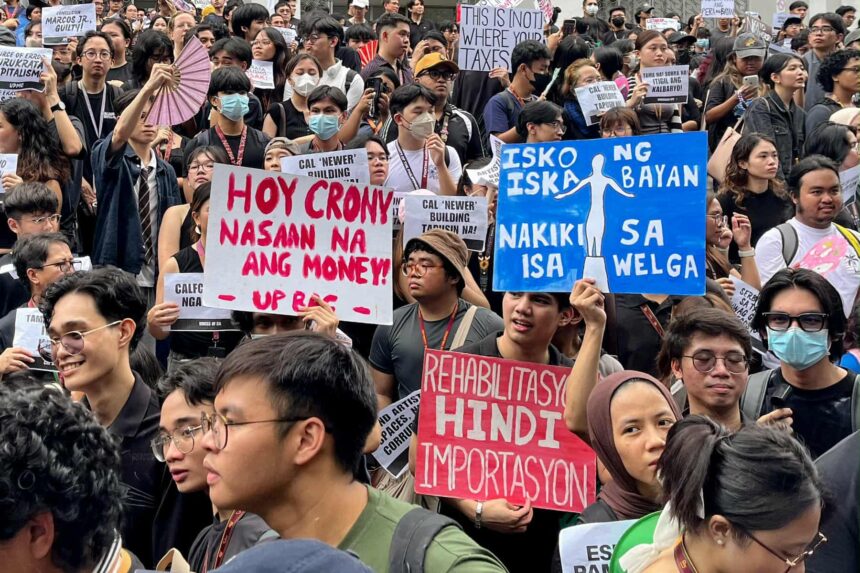
Tinio highlighted that public funds must go to education, health and housing, instead of corruption.
“Di naman nasosolusyunan ang baha,” he said, as he noted that flood control projects were allocated P250 billion.
Government flood mitigation projects are now the center of corruption scandal, where the funds allegedly ended up in the pockets of unscrupulous contractors and solons. (Joseph Pedrajas)