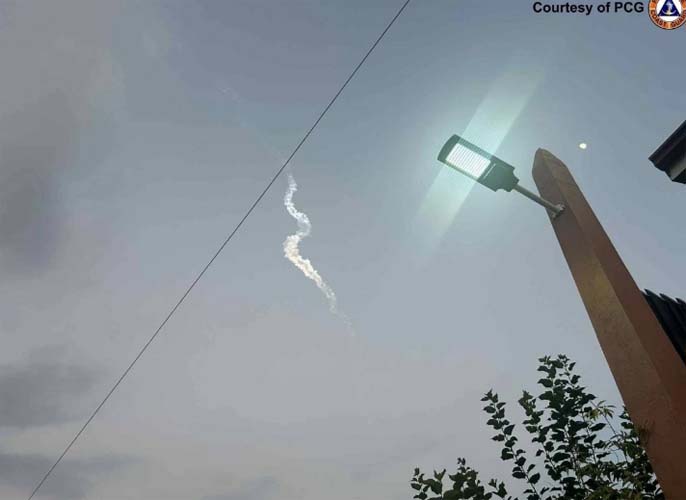
Five loud explosions that sparked panic among residents in Palawan were linked to a rocket launch conducted by China, the Philippine Coast Guard (PCG) confirmed on Tuesday, August 5.
The series of blasts—described by locals as “booming sounds”—were heard across eastern Palawan on Monday night, August 4.
Netizens also reported a visible condensation trail in the sky, consistent with rocket exhaust or propulsion.
Social media posts noted particularly strong explosions around 6:38 p.m. in Plaridel, Aborlan, Palawan.
Other reports came from Barangay Cabigaan, Aborlan; Barangay San Jose, Puerto Princesa City; and Barangay Caguisan, Narra.
According to PCG spokesperson for the West Philippine Sea, Commodore Jay Tarriela, these events aligned with the agency’s prior advisory about a scheduled rocket launch from China.
“This activity corresponds to the scheduled launch of China’s Long March 12 rocket, as detailed in the PCG’s prior advisory to the public,” Tarriela said.
In an earlier notice, the National Disaster Risk Reduction and Management Council (NDRRMC) warned of possible falling debris from the People’s Republic of China’s (PRC) Long March 12 rocket, launched from the Hainan International Commercial Launch Center in Wenchang, Hainan between 6:14 p.m. and 6:42 p.m. on Monday.
The rocket was intended to deploy low-orbit satellites.
Parts of the rocket were expected to fall within two designated drop zones: approximately 21 nautical miles from Puerto Princesa, Palawan, and 18 nautical miles from Tubbataha Reef Natural Park.
The Philippine Space Agency (PhilSA) cautioned the public against approaching or retrieving any rocket debris due to the potential danger from toxic substances such as leftover rocket fuel. (Martin Sadongdong)